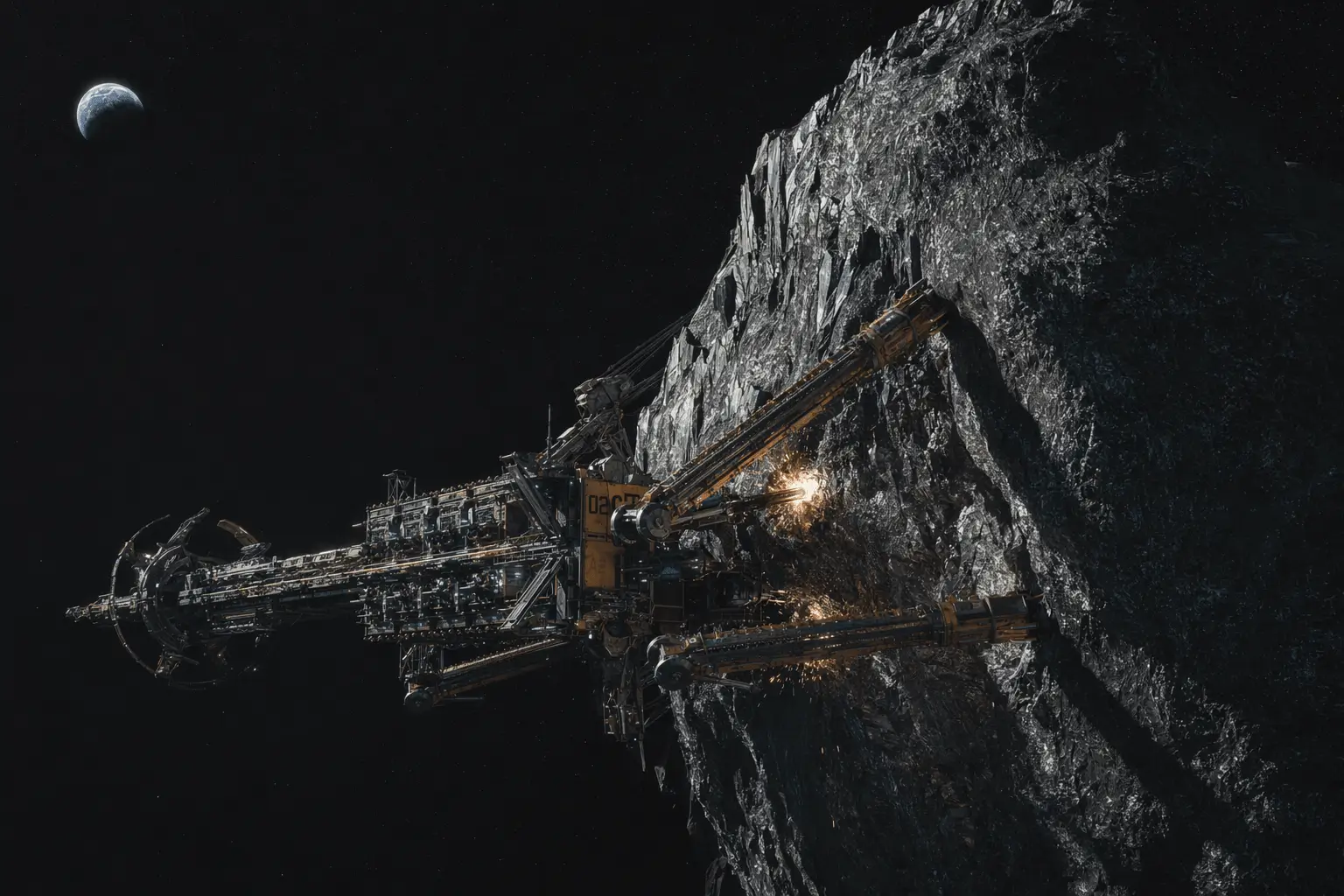
For all of human history, our economic output has been strictly constrained by the physical limits of our planet. Every ounce of gold, every barrel of oil, and every kilogram of rare earth metal used in our technology was extracted from the Earth’s crust. As our global population swells and our transition to green energy demands exponentially more raw materials, we are rapidly approaching a hard ceiling on terrestrial resources.
The solution, proposed by a growing cohort of aerospace engineers and venture capitalists, is as radical as it is necessary: we must expand our industrial supply chain into the solar system. Asteroid mining, once the exclusive domain of science fiction, is rapidly becoming a viable, heavily capitalized business proposition.
The incentives are mind-boggling. A single, metallic M-type asteroid, such as 16 Psyche, is estimated to contain enough iron, nickel, and precious metals to dwarf the entire global economy. In this deep dive, we will explore the technological roadmap to off-world extraction, the staggering economics of space commodities, and the chaotic legal framework that threatens to turn the cosmos into the Wild West.
The Economic Imperative: Why Leave Earth?
The push toward space mining is driven by two distinct economic imperatives: the terrestrial demand for critical minerals, and the necessity of building an in-space supply chain for further exploration.
Terrestrial Resource Scarcity
As we explored in our analysis of the global tariff shifts and their market impact, the geopolitical battle for “rare earth elements” (REEs) is intensifying. These elements are absolutely critical for manufacturing everything from the lithium-ion batteries in electric vehicles to the permanent magnets in wind turbines and the microchips in military fighter jets.
Currently, the global supply of these elements is heavily concentrated in a few nations, creating massive supply chain vulnerabilities. Asteroids are essentially flying mountains of these exact materials. Mining a single, modestly sized near-Earth asteroid could yield more platinum group metals (PGMs) than have ever been mined in human history, instantly crashing global commodity prices and securing the supply chain for the green energy transition.
The In-Space Economy
However, the most immediate market for space mining is not Earth; it is space itself. The fundamental bottleneck of space exploration is the “rocket equation.” Escaping Earth’s gravity well is incredibly expensive. Every kilogram of fuel, water, or building material launched into orbit costs thousands of dollars.
As we discussed regarding the viability of space tourism and commercial space stations, building massive structures in orbit requires a localized supply chain. The first “killer app” of space mining is not returning gold to Earth; it is mining water ice from asteroids or the Moon. In space, water can be separated into hydrogen and oxygen using solar power, creating rocket fuel.
An asteroid mining company that can establish a “gas station” in low Earth orbit, selling locally mined fuel to satellite operators and deep-space missions, will hold the monopoly on the foundational commodity of the entire space economy.
The Technological Feasibility: How Do We Mine a Rock in a Vacuum?
The economic theory is sound, but the engineering challenges of mining an asteroid are unprecedented. We are not simply putting a traditional terrestrial excavator on a rocket.
Prospecting and Capture
The first challenge is prospecting. There are millions of asteroids, but they are not created equal. Some are solid chunks of metal; others are loose “rubble piles” held together by microgravity. Mining companies are currently deploying fleets of small, cheap “CubeSats” equipped with advanced spectrometry to scan near-Earth asteroids, identifying their chemical composition before committing to a costly extraction mission.
Once a viable target is identified, the spacecraft must rendezvous and anchor itself. In microgravity, the simple act of drilling into a rock will push the spacecraft away. Engineers are designing complex anchoring systems, ranging from harpoons to massive, enclosing “bags” that swallow smaller asteroids entirely.
Extraction and Refinement
Traditional mining relies heavily on gravity and massive amounts of water to separate ore from rock. Neither exists in space.
Instead, companies are developing novel techniques like “optical mining.” This involves using massive, concentrated solar reflectors to focus the sun’s energy onto the asteroid, literally vaporizing the surface. The volatile materials (like water) sublimate into a gas, which is then captured and frozen in a cold trap. For solid metals, autonomous robotic swarms, similar to those being developed for precision agriculture, will use lasers or advanced magnetic separation to extract valuable ores without the need for toxic terrestrial chemicals.
The Legal Vacuum: Who Owns Outer Space?
The most significant barrier to the commercialization of space is not engineering; it is the law. The current legal framework governing outer space is a relic of the Cold War, completely unequipped to handle private commercial enterprise.
The Outer Space Treaty of 1967
The foundational document of space law is the Outer Space Treaty, drafted by the United Nations in 1967. Driven by the fear of the US and USSR placing nuclear weapons in orbit, the treaty explicitly states that “Outer space, including the moon and other celestial bodies, is not subject to national appropriation by claim of sovereignty.”
In short: no country can own the Moon or an asteroid.
The Property Rights Dilemma
This creates a massive problem for commercial mining. If you cannot own an asteroid, can you legally own the minerals you extract from it?
Capitalism requires property rights. No venture capital firm will invest $5 billion into a robotic mining mission if the legal status of the extracted platinum is ambiguous. If an American company mines an asteroid, can a Chinese company legally intercept the cargo ship on its way back to Earth, arguing that the minerals belong to the “common heritage of mankind”?
To bypass this ambiguity, nations are beginning to pass unilateral legislation. The United States passed the Commercial Space Launch Competitiveness Act in 2015, which explicitly grants US citizens the right to own, transport, and sell asteroid resources. Other nations, like Luxembourg and the UAE, have passed similar laws to attract space startups. However, this fragmented, unilateral approach is creating a highly volatile legal environment, raising the specter of future international conflict over off-world resource claims.
The Role of Government and Public-Private Partnerships
Because the capital requirements are so immense and the legal framework so fragile, asteroid mining cannot be accomplished by private enterprise alone. It requires massive public-private partnerships.
Agencies like NASA are currently acting as the anchor customer for the nascent space economy. Through programs like the Artemis mission, NASA is aggressively contracting private companies to develop lunar landers, rovers, and in-situ resource utilization (ISRU) technologies. By providing guaranteed government contracts, these agencies are de-risking the technology and creating a foundational market that private companies can eventually leverage for commercial asteroid mining.
Conclusion: The Trillionaire Frontier
The timeline for commercial asteroid mining is frequently debated. Optimists predict the first commercial fuel depots operating in orbit within the decade; pessimists argue it is a 50-year horizon.
Regardless of the exact date, the trajectory is clear. The convergence of reusable rockets (drastically lowering launch costs), advanced autonomous robotics, and the terrestrial desperation for green energy materials makes off-world extraction an eventual certainty.
The first company to successfully return a commercial payload of off-world resources will trigger an economic gold rush unlike anything seen in human history. The individuals who successfully navigate the staggering engineering challenges and the chaotic legal vacuum of space mining will not just be billionaires; they will likely be the world’s first trillionaires, dictating the economic future of humanity among the stars.