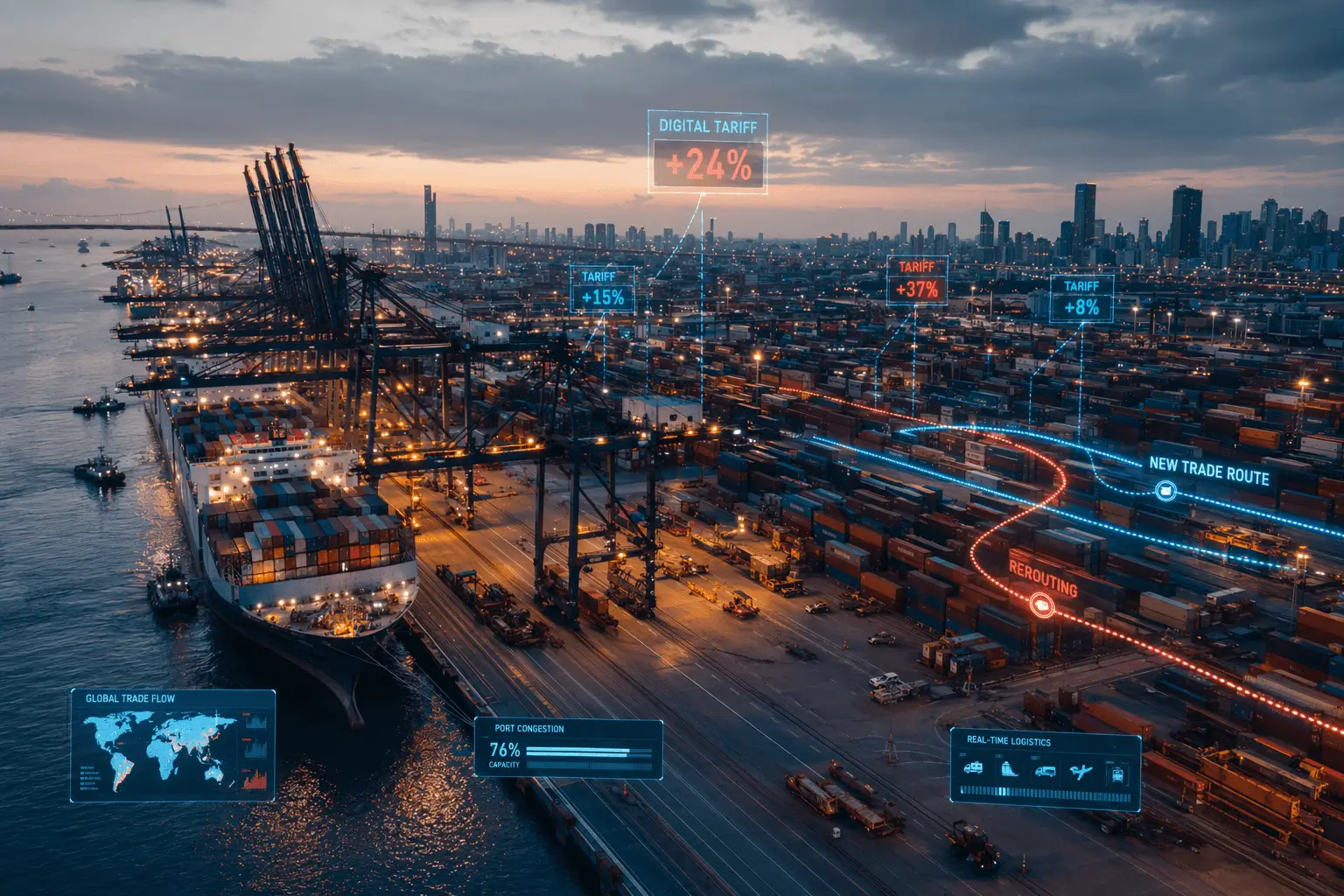
Global trade policy is in flux. From semiconductor export controls to agricultural tariffs, the rules governing international commerce are being rewritten at an unprecedented pace. For investors, multinational corporations, and everyday consumers, understanding these structural shifts isn’t just an intellectual exercise - it is an essential requirement for navigating the modern economic landscape.
In this deep dive, we’ll explore the monumental changes in global tariff structures taking place in 2025. We’ll unpack the underlying causes, dissect the immediate and long-term market impacts, and outline actionable strategies for those looking to adapt to a world where free trade is no longer the default setting.
The End of the Free Trade Consensus
For the better part of the last thirty years, the global economic order operated on a relatively simple consensus: lower trade barriers, integrated supply chains, and just-in-time manufacturing were the keys to unprecedented prosperity. The World Trade Organization (WTO) served as the ultimate arbiter, and “globalization” was practically synonymous with “progress.”
However, cracks in this system began to emerge in the late 2010s. Driven by rising geopolitical tensions, concerns over supply chain resilience (highlighted starkly during the early 2020s), and a resurgence of economic nationalism, countries began to wield tariffs not just as economic tools, but as primary weapons of foreign policy.
By 2025, this trend has solidified into a new normal. We are moving from an era of free trade maximalism toward a much more complex, multi-polar trade architecture. This shift is characterized by friend-shoring, strategic decoupling, and the aggressive use of tariffs to protect critical domestic industries.
To fully grasp the magnitude of this shift, one must understand that tariffs are fundamentally taxes on consumption. When a government levies a tariff on an imported good, the exporting company does not pay that tax; the importing company does. This cost is inevitably passed down the supply chain, ultimately landing on the final consumer or squeezing the margins of the businesses involved.
The Current Landscape: Key Policy Shifts in 2025
The landscape of 2025 has brought a wave of new, highly targeted trade policies. These are not broad, indiscriminate tariffs, but rather surgical strikes aimed at specific sectors and technologies.
1. Escalation of US-China Tech Tariffs
The most significant tectonic shift is the continued escalation of tariffs and export controls between the United States and China. What began as a dispute over steel and consumer goods has morphed into a battle for technological supremacy.
In 2025, the US has implemented sweeping new restrictions and tariffs specifically targeting foundational technologies. This includes advanced artificial intelligence chips, semiconductor manufacturing equipment, and rare earth minerals critical for electric vehicle (EV) battery production. If you want to understand how this impacts the broader tech ecosystem, you can read our analysis on how AI agents are reshaping business workflows.
The objective is clear: to slow the technological advancement of a strategic competitor while simultaneously trying to incubate a domestic manufacturing base. The market impact has been profound. Semiconductor companies with heavy reliance on Chinese revenue have seen significant volatility, while firms positioned to benefit from domestic subsidies (such as those tied to the CHIPS Act) have seen structural re-ratings.
2. The Implementation of EU Carbon Border Adjustments
While the US-China dynamic dominates headlines, the European Union has quietly implemented one of the most consequential trade policies in decades: the Carbon Border Adjustment Mechanism (CBAM).
Fully active in 2025, CBAM essentially applies a tariff on carbon-intensive products (like steel, cement, fertilizers, and electricity) imported into the EU. The tariff is calculated based on the carbon emissions generated during the product’s manufacturing process.
This policy is revolutionary. It effectively prices carbon globally by forcing external manufacturers to pay a premium if their environmental regulations are less stringent than the EU’s. For markets, this creates an immediate competitive advantage for “green” manufacturers globally. Companies operating in jurisdictions with lax environmental laws are suddenly finding themselves priced out of the lucrative European market, forcing a massive reallocation of capital toward sustainable manufacturing technologies.
3. Emerging Market Retaliatory Tariffs
We are also witnessing the rise of emerging markets flexing their economic muscles. Countries in Southeast Asia, Latin America, and parts of Africa are no longer content to simply be the providers of raw materials.
In response to Western tariffs and in an effort to move up the value chain, several emerging markets have implemented retaliatory tariffs or outright export bans on unprocessed critical minerals. For instance, countries rich in lithium and nickel are increasingly demanding that refining and battery manufacturing take place within their borders before the resources can be exported.
This localization of supply chains creates friction and higher costs in the short term, but also presents massive infrastructure investment opportunities in these developing regions.
How Tariffs Ripple Through the Markets
Understanding the high-level policy is only half the battle. The real value for investors lies in anticipating how these tariffs ripple through the economy in predictable patterns. We can categorize these impacts into three main areas: supply chain costs, currency effects, and sector rotation.
Supply Chain Costs and the End of Just-In-Time
When tariffs increase the cost of imported components, manufacturers face a difficult triad of choices: they can absorb the cost (compressing their profit margins), pass the cost onto consumers (risking lower sales volume and contributing to inflation), or restructure their supply chains (incurring massive capital expenditures).
For the past several decades, corporate efficiency was driven by “just-in-time” manufacturing - sourcing the cheapest components globally with minimal inventory. The new tariff regime makes this model inherently fragile, accelerating how supply chain logistics are being revolutionized by blockchain. We are now seeing a transition to “just-in-case” manufacturing.
Companies are holding higher inventories, sourcing from multiple overlapping suppliers across different geopolitical zones, and prioritizing proximity to the end consumer. While this creates a more resilient supply chain, it is structurally more expensive. This inherently inflationary pressure is forcing central banks to rethink their long-term interest rate targets, which in turn dramatically affects equity valuations.
Currency Effects and FX Volatility
Currencies act as the shock absorbers of the global economy. When a country faces significant new tariffs on its exports, its currency often depreciates. This happens because the tariffs reduce demand for the country’s goods, which in turn reduces demand for its currency.
Conversely, countries implementing tariffs to protect domestic industries might see their currency strengthen in the short term as imports decrease. However, if those tariffs spark a trade war that slows global growth, capital often flees to perceived safe-haven currencies like the US Dollar or the Swiss Franc.
For multinational corporations, this tariff-induced foreign exchange (FX) volatility is a massive headache. Earnings generated overseas can be wiped out by sudden currency swings. As a result, corporate treasuries are spending unprecedented amounts on complex currency hedging strategies. Investors must scrutinize a company’s FX exposure more closely than ever; an impressive earnings beat in local currency can quickly become a miss when translated back to the reporting currency.
Sector Rotation and Capital Reallocation
Perhaps the most visible market impact of shifting tariffs is sector rotation. As trade barriers rise, investors aggressively reallocate capital based on perceived tariff exposure.
Domestic manufacturers, particularly those in strategic industries like semiconductors, clean energy infrastructure, and defense, often become the immediate beneficiaries of tariffs. Protected from cheaper foreign competition, they gain pricing power and market share.
On the flip side, import-dependent sectors face severe headwinds. Retailers who rely heavily on imported consumer goods find their margins squeezed. Technology hardware companies with highly concentrated, single-country supply chains are viewed as high-risk investments, suffering multiple compressions as investors demand a higher risk premium.
Companies that specialize in helping others navigate complex customs regulations, source alternative suppliers, and automate manufacturing are experiencing a golden age of growth, as frequently reported by global financial outlets like Bloomberg. For a broader perspective on how businesses are evolving, you can read more about modern stochastic processes in business strategy.
What Smart Investors Are Watching
In a landscape characterized by constant policy shifts, reactive trading is a losing game. Strategic positioning requires anticipating the next move. Here are the key themes and signals that sophisticated investors are monitoring in 2025.
1. Supply Chain Diversification Plays
The most obvious investment theme is the “China Plus One” (or Two, or Three) strategy. Companies are actively diversifying their manufacturing bases away from highly concentrated areas.
Investors are looking closely at nations positioned to capture this diverted manufacturing capacity. Countries like Mexico, India, Vietnam, and Poland are seeing massive inflows of foreign direct investment. Real estate developers building industrial parks in these regions, regional banks financing the expansions, and local logistics companies are all prime targets for investment capital.
2. Domestic Substitution and Automation
As tariffs make imported goods more expensive, domestic substitution becomes economically viable. However, bringing manufacturing back to high-wage developed nations requires heavy reliance on automation to remain competitive.
Consequently, robotics companies, industrial automation software providers, and AI-driven quality control systems are seeing surging demand. If a company can offer a technological solution that offsets the higher labor costs of domestic manufacturing, they possess immense pricing power in the current environment.
3. Deep Dive into Corporate Hedging
As mentioned earlier, currency and input cost volatility are at all-time highs. Investors must read the footnotes of corporate earnings reports. How effectively is a company hedging its exposure? Are they locking in long-term contracts for critical materials, or are they exposed to spot market volatility?
Companies with strong balance sheets, sophisticated treasury departments, and the pricing power to pass on localized inflation will structurally outperform those who are at the mercy of geopolitical whims.
4. Policy Reversal and Negotiation Signals
Finally, trade policy is ultimately a political negotiation. Tariffs are often used as leverage. The most lucrative (and risky) plays involve anticipating when tariffs might be rolled back or adjusted.
Monitoring diplomatic backchannels, tracking the lobbying efforts of major multinational corporations, and understanding the domestic political pressures of the countries involved can provide early signals of a policy shift. A sudden relaxation of tariffs on a specific sector can trigger massive short-squeezes and rapid upward re-ratings.
The Bigger Picture: Navigating the New Normal
It is tempting to view these tariff shifts as temporary aberrations - a brief detour from the inevitable march of globalization. This is a dangerous assumption. The geopolitical landscape has fundamentally altered. The prioritization of national security and supply chain resilience over pure economic efficiency is a structural change, not a cyclical one.
In a world of shifting tariffs and fragmented trade, the most valuable asset a company or an investor can possess is adaptability.
We are entering an era of “Stochastic Trade” - where unpredictable policy shifts create sudden risks and fleeting opportunities. The companies that thrive will be those with flexible supply chains, diversified revenue streams, and the ability to rapidly relocate capital and resources.
The investors who succeed will be those who move beyond simplistic models of global growth. They will need to be part geopolitical analysts, part supply chain experts, and part traditional financial analysts. They must understand not just what a company sells, but precisely where its components come from, how they are taxed at every border crossing, and how vulnerable that chain is to the stroke of a policymaker’s pen.
In the coming months, we will be publishing highly detailed, sector-by-sector analyses of how these tariff impacts are shaking out. From the intricacies of the global semiconductor supply chain to the surprising beneficiaries of agricultural trade wars, we will provide the context needed to make informed decisions in a complex world.
The era of easy, frictionless globalization may be behind us, but the era of strategic, localized opportunity is just beginning. Stay sharp, stay adaptable, and continue following the shifting patterns of the global economy.