The global agricultural system faces an unprecedented, dual-pronged crisis. By the year 2050, the global population is projected to reach nearly 10 billion people. To feed this population, the Food and Agriculture Organization (FAO) estimates that global food production must increase by a staggering 60%.
Simultaneously, the agricultural sector is under immense pressure to drastically reduce its environmental footprint. Traditional industrial farming is highly resource-intensive, consuming vast amounts of fresh water, degrading topsoil, and contributing significantly to global greenhouse gas emissions through the heavy use of synthetic fertilizers and diesel machinery.
We must produce drastically more food, using drastically less land and fewer resources. The traditional solution - simply clearing more forests for arable land or applying more chemical fertilizer - is no longer physically or politically viable. The answer to this existential math problem lies in “Precision Agriculture,” a massive technological shift that applies the rigorous data analysis of Silicon Valley to the ancient practice of growing food.
The Anatomy of a Smart Farm
Historically, farming has been a game of averages. A farmer would look at a 100-acre field, take a few soil samples, and then apply a uniform amount of water, fertilizer, and pesticide across the entire acreage based on an estimated average need.
Precision agriculture throws out the concept of the average. It recognizes that the nutrient profile, moisture level, and pest pressure can vary drastically meter by meter within the exact same field. By treating the farm not as a single entity, but as millions of individual, hyper-local micro-environments, farmers can optimize their inputs with surgical precision.
The Sensor Network: The Farm’s Nervous System
The foundation of precision agriculture is the Internet of Things (IoT). As we discussed in our exploration of the impact of 5G and smart cities, the ability to deploy thousands of cheap, connected sensors is revolutionizing physical infrastructure.
On a modern farm, ruggedized IoT sensors are buried in the soil to monitor moisture, salinity, and nitrogen levels in real-time. Above ground, micro-weather stations track highly localized humidity and temperature fluctuations. This creates a continuous, high-fidelity data stream representing the exact physical state of the farm.
The Aerial View: Drones and Satellites
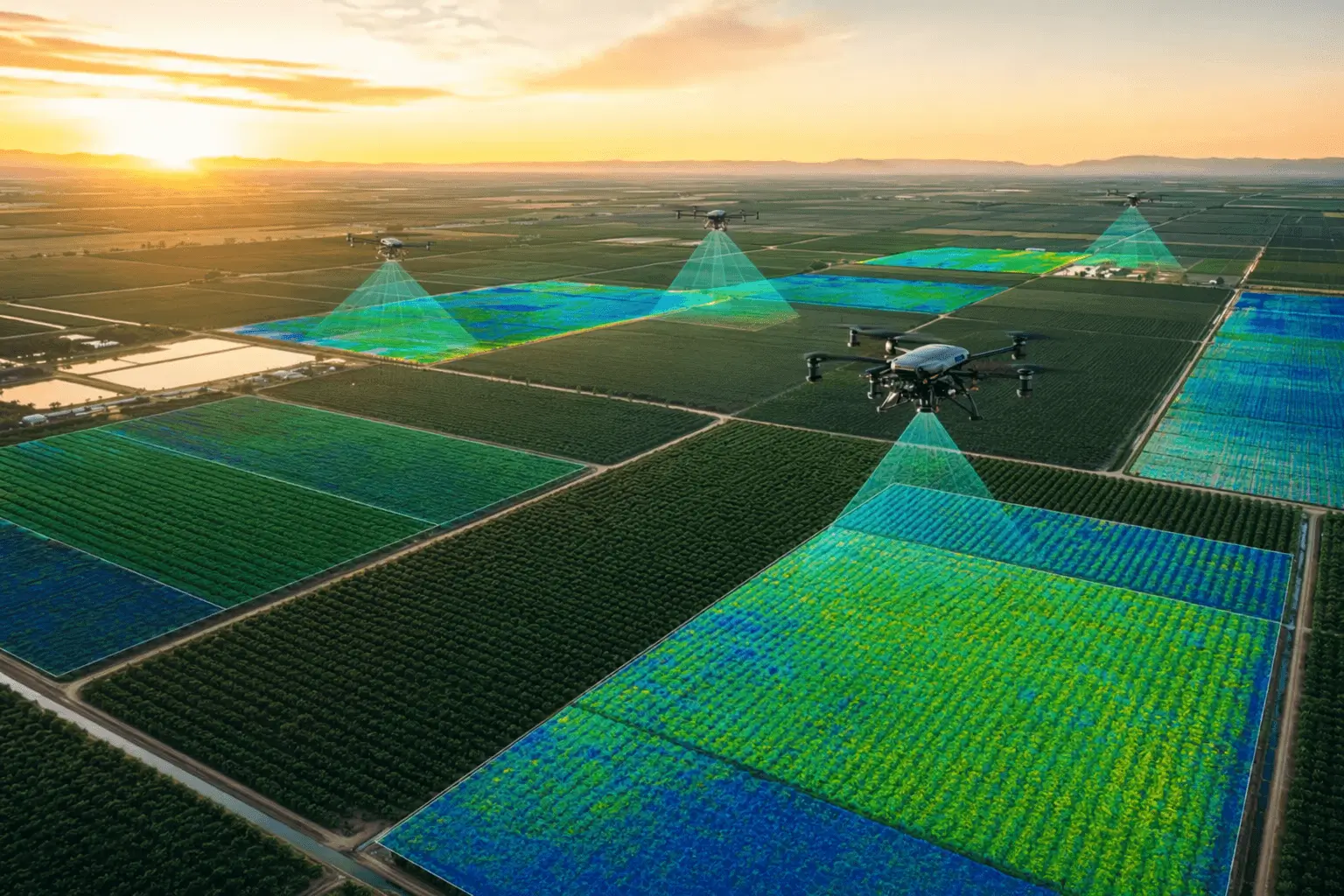
While ground sensors provide depth, aerial imaging provides breadth. Satellites equipped with multi-spectral cameras orbit the earth, capturing images of crop health that highlight issues invisible to the naked human eye.
For even greater resolution, autonomous drones fly pre-programmed routes over the fields. These drones can utilize thermal imaging to identify exactly which plants are experiencing “water stress” before the leaves even begin to wilt, allowing the irrigation system to deploy water only to the specific square meters that need it, saving millions of gallons of water annually.
AI and Autonomous Machinery
Data collection is only the first step. The true value of precision agriculture is unlocked when that massive data stream is ingested by Artificial Intelligence and used to orchestrate autonomous machinery.
Predictive Analytics and Yield Optimization
The variables affecting a crop yield are nearly infinite: historical weather patterns, specific seed genetics, soil microbiomes, and localized pest migrations. Human intuition, even backed by generations of farming experience, cannot process this many variables simultaneously.
AI algorithms can. By analyzing historical yield data against current sensor inputs, AI platforms can provide highly specific, actionable recommendations. The software might advise a farmer to delay planting by three days to avoid a predicted localized frost, or to switch to a specific drought-resistant seed variant for the western half of the field.
The Rise of the Robot Tractor
The most visible manifestation of precision agriculture is the automation of heavy machinery. Companies like John Deere are no longer just tractor manufacturers; they are advanced robotics and software companies.
Modern tractors are essentially massive, rolling data centers. Equipped with GPS guidance systems accurate to the centimeter, autonomous tractors can navigate a field with perfect precision, operating 24 hours a day. More impressively, they are equipped with advanced computer vision systems. As an automated sprayer moves through a field, cameras analyze every single plant. If the AI identifies a weed, it triggers a micro-burst of herbicide targeting only that specific weed, rather than indiscriminately spraying the entire crop row. This “see and spray” technology can reduce chemical usage by up to 80%, massive cost savings for the farmer and a massive win for the surrounding ecosystem.
The Convergence with Synthetic Biology
Precision agriculture does not stop at the mechanical and digital levels; it is increasingly converging with the biological level. As we explored in our deep dive on the trillion-dollar synthetic biology industry, we now have the tools to engineer the fundamental building blocks of life.
Engineered Microbiomes
Rather than relying solely on synthetic, petrochemical fertilizers, researchers are engineering soil microbes. By coating seeds in a proprietary blend of synthetic microbes designed to fix nitrogen directly from the atmosphere, farmers can significantly reduce their reliance on traditional fertilizers.
Furthermore, precision data allows farmers to track exactly how these engineered microbiomes perform in different soil types across their farm, creating a feedback loop that allows biotech companies to constantly refine and optimize their biological products.
The Business Hurdles: Connectivity and Capital
While the technology is miraculous, the widespread adoption of precision agriculture faces severe structural hurdles.
The Rural Connectivity Gap
The entire precision agriculture ecosystem relies on the seamless transmission of massive amounts of data. The autonomous tractor must communicate with the drone, which must communicate with the cloud server.
However, many of the world’s most productive agricultural regions suffer from a severe lack of broadband internet infrastructure. You cannot run a smart farm on a patchy 3G cellular connection. Bridging the “rural digital divide” through the deployment of rural 5G networks or low-earth orbit satellite internet (like Starlink) is an absolute prerequisite for scaling precision agriculture globally.
The Capital Expenditure Barrier
Upgrading a traditional farm to a smart farm requires a massive capital expenditure. Advanced sensor networks, autonomous tractors, and expensive software subscriptions are often out of reach for small-to-medium-sized family farms.
This capital barrier threatens to accelerate the consolidation of the agricultural industry. Only massive, corporate farming conglomerates possess the balance sheets required to invest in these efficiency-driving technologies. This could lead to a highly bifurcated agricultural landscape: technologically advanced mega-farms dominating global commodity production, while smaller farms struggle to remain economically competitive.
Conclusion: A Data-Driven Harvest
The era of intuitive, generalized farming is coming to a close. To meet the existential challenges of the 21st century, agriculture must transition into a highly precise, data-driven engineering discipline.
Precision agriculture represents the ultimate convergence of hardware, software, and wetware (biology). It promises a future where we can maximize the caloric output of every single square meter of arable land while minimizing our extraction of natural resources. For technology investors, ag-tech represents a massive, relatively untapped market. For the rest of humanity, it represents our best hope for ensuring a secure, sustainable global food supply in an increasingly volatile world.