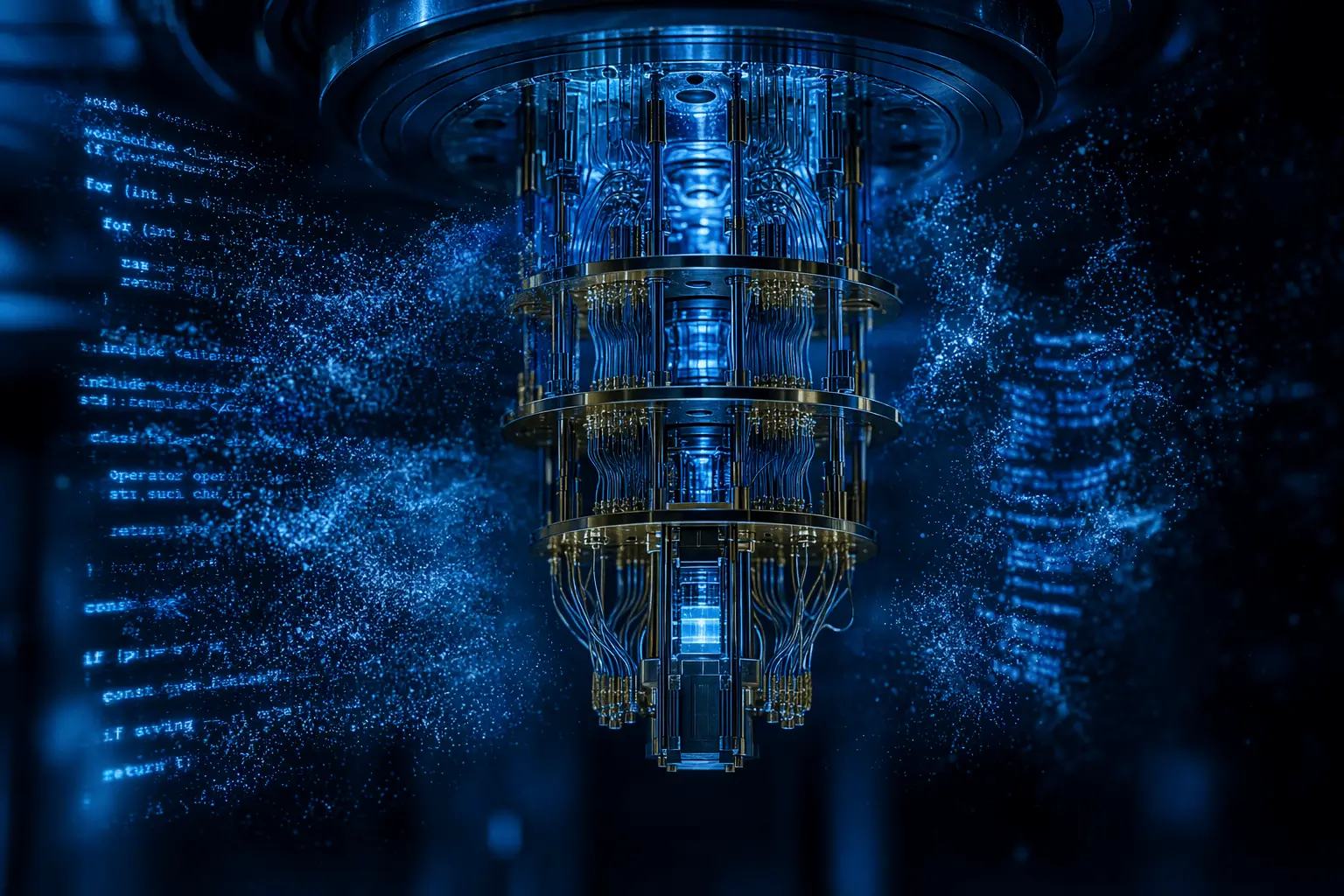
For decades, the foundation of digital trust has rested on a fundamental mathematical reality: some problems are simply too hard for classical computers to solve in any reasonable timeframe. When you log into your bank, send an encrypted message, or make a secure purchase online, your data is protected by cryptographic algorithms like RSA or Elliptic Curve Cryptography (ECC). These systems rely on the computational difficulty of factoring large prime numbers - a task that would take the world’s fastest supercomputers thousands of years to crack.
However, a technological revolution is quietly brewing in research laboratories around the world. Quantum computing, a field that leverages the bizarre principles of quantum mechanics, threatens to shatter this mathematical foundation. The looming advent of cryptographically relevant quantum computers (CRQCs) has given rise to a theoretical event known as “Q-Day” - the moment when a quantum computer successfully breaks standard public-key cryptography.
For business leaders, IT professionals, and policymakers, understanding the quantum threat is no longer an academic exercise; it is an urgent strategic imperative. Much like the disruption caused by autonomous AI agents in the enterprise software space, quantum computing will force a fundamental reimagining of our digital infrastructure.
The Mechanics of the Quantum Threat
To grasp why quantum computers are so dangerous to modern encryption, one must understand how they differ from classical computers.
Qubits and Superposition
Classical computers process information using bits, which can exist in one of two states: 0 or 1. Quantum computers use quantum bits, or qubits. Thanks to a principle called superposition, a qubit can exist in a state of 0, 1, or any combination of both simultaneously. This allows quantum computers to process a vast number of possibilities concurrently, rather than sequentially.
Entanglement and Shor’s Algorithm
Another critical quantum principle is entanglement, where qubits become inextricably linked, regardless of the physical distance between them. Changing the state of one entangled qubit instantaneously affects the other.
In 1994, mathematician Peter Shor developed an algorithm that demonstrated how a sufficiently powerful quantum computer could leverage these principles to find the prime factors of an integer exponentially faster than any known classical algorithm. Shor’s Algorithm proved that the mathematical locks securing the internet could, in theory, be picked almost instantly by a quantum machine.
While early quantum computers were too small and error-prone to run Shor’s algorithm on large numbers, the hardware is rapidly catching up to the theory. Companies like IBM, Google, and various well-funded startups are in a race to build machines with thousands, and eventually millions, of stable qubits.
The “Harvest Now, Decrypt Later” Attack
A common misconception is that businesses do not need to worry about the quantum threat until Q-Day actually arrives - an event that experts predict is still 5 to 15 years away. This complacency ignores a critical and ongoing attack vector known as “Harvest Now, Decrypt Later” (HNDL) or “Store Now, Decrypt Later.”
In an HNDL attack, nation-state actors and sophisticated cybercriminal syndicates actively intercept and harvest encrypted data traversing the internet today. They cannot currently read this data, but they store it in massive data centers. The strategy is to stockpile sensitive information - such as trade secrets, financial records, military intelligence, and personal health data - and wait until a CRQC becomes available to decrypt it retroactively.
This means that any data with a long shelf life of confidentiality is already at risk. If your company transmits proprietary intellectual property today using RSA encryption, an adversary could be storing it right now, planning to decrypt it in a decade when that IP might still hold immense value. The quantum threat is not a future problem; it is a present-day vulnerability.
The Business Impact of Q-Day
The realization of Q-Day will not just be a technical glitch; it will be a systemic shock to the global economy. Every digital system that relies on public-key cryptography will be compromised.
Financial Chaos and Disrupted Supply Chains
The financial sector is particularly vulnerable. Trillions of dollars flow through global banking networks daily, secured by encryption. If these networks are compromised, the integrity of financial transactions cannot be guaranteed, potentially leading to a freeze in global commerce. Similarly, modern supply chains, which rely on secure digital ledgers and communication networks, would be thrown into chaos.
The Erosion of Digital Trust
Beyond direct financial losses, the erosion of digital trust would be catastrophic. The digital economy functions because consumers and businesses trust that their interactions are secure. If that trust is broken by widespread cryptographic failures, the economic fallout would be immeasurable. Software updates, secure emails, digital signatures, and virtual private networks (VPNs) would all be rendered untrustworthy.
The shift toward quantum-safe systems is as critical to global stability as navigating the global tariff shifts and market impacts we have seen disrupting international trade.
The Solution: Post-Quantum Cryptography (PQC)
The cybersecurity community is not standing idle in the face of this threat. For years, cryptographers and mathematicians have been developing Post-Quantum Cryptography (PQC) - new cryptographic algorithms designed to be secure against both classical and quantum computers.
Unlike current public-key cryptography, which relies on factoring prime numbers or the discrete logarithm problem, PQC algorithms rely on different, more complex mathematical problems. One of the most promising approaches is lattice-based cryptography, which involves hiding information within complex, multi-dimensional geometric structures.
The NIST Standardization Process
The National Institute of Standards and Technology (NIST) in the United States has been leading a global effort to evaluate and standardize PQC algorithms. In recent years, NIST has announced the selection of several algorithms for standardization, marking a critical milestone in the transition to a quantum-safe future.
These standardized algorithms will form the new bedrock of digital security. However, having the algorithms is only the first step. The monumental challenge lies in implementing them across the global digital ecosystem.
The Transition: A Decade-Long Migration
Upgrading the internet’s cryptographic infrastructure is an undertaking of unprecedented scale. It is often compared to the Y2K bug, but exponentially more complex. While Y2K required fixing a known date formatting issue in specific software, the quantum migration requires replacing the fundamental cryptographic protocols deeply embedded in operating systems, web browsers, networking hardware, and IoT devices.
Cryptographic Agility
The transition to PQC will not happen overnight. For a significant period, organizations will need to operate in a hybrid state, supporting both classical and quantum-safe algorithms. This requires a concept known as “cryptographic agility” - the ability of an IT system to rapidly switch between different cryptographic algorithms without requiring significant changes to the underlying infrastructure.
Historically, cryptography has been hardcoded into applications, making updates slow and painful. Achieving cryptographic agility requires a fundamental shift in software architecture, abstracting cryptographic functions so they can be swapped out easily as standards evolve.
The Inventory Problem
One of the biggest hurdles organizations face in the PQC migration is simply knowing where cryptography is used within their networks. Many businesses have sprawling, complex IT environments with legacy systems and shadow IT. Cryptography is often deeply buried in software libraries, certificates, and proprietary protocols.
Before an organization can migrate to PQC, it must conduct a comprehensive cryptographic inventory. They need to know what algorithms are in use, where the encryption keys are stored, and what data is being protected. Without this visibility, a successful migration is impossible.
Actionable Steps for Business Leaders
The threat is clear, and the solution is emerging, but the window for preparation is closing. Business leaders must take proactive steps today to ensure their organizations survive the quantum transition.
- Acknowledge the Threat: Quantum computing is not science fiction; it is an engineering challenge that is being solved rapidly. The board of directors and executive leadership must understand the business risks associated with Q-Day and the HNDL attack vector.
- Establish a Quantum Readiness Program: Organizations should form a dedicated cross-functional team, including IT, security, legal, and risk management, to oversee the PQC migration.
- Conduct a Cryptographic Inventory: Utilize automated tools to discover and map all cryptographic assets within the organization. This inventory should be treated as a living document, constantly updated as the IT environment changes.
- Prioritize Data and Systems: Not all systems need to be migrated simultaneously. Organizations must prioritize their migration efforts based on the value and shelf-life of the data being protected. Systems handling highly sensitive, long-lasting data should be migrated first.
- Demand Cryptographic Agility from Vendors: Businesses must hold their software and hardware vendors accountable. When procuring new systems, require that they demonstrate cryptographic agility and a clear roadmap for supporting NIST-standardized PQC algorithms.
- Begin Testing and Piloting: While the final NIST standards are still being codified, organizations should begin testing the draft algorithms in non-production environments to understand their performance characteristics and integration challenges.
Conclusion: The Race Against Time
The advent of quantum computing represents a paradigm shift in technology, offering the potential to solve incredibly complex problems in medicine, materials science, and artificial intelligence. However, this same power poses an existential threat to the digital security infrastructure that underpins the modern world.
Q-Day is coming, and the “Harvest Now, Decrypt Later” threat is already here. The transition to Post-Quantum Cryptography will be one of the most significant and complex IT projects in history, requiring years of planning, investment, and execution. Organizations that view this transition as a distant problem will find themselves hopelessly behind when the quantum era finally dawns. The time to prepare for the quantum threat is not tomorrow; it is today.