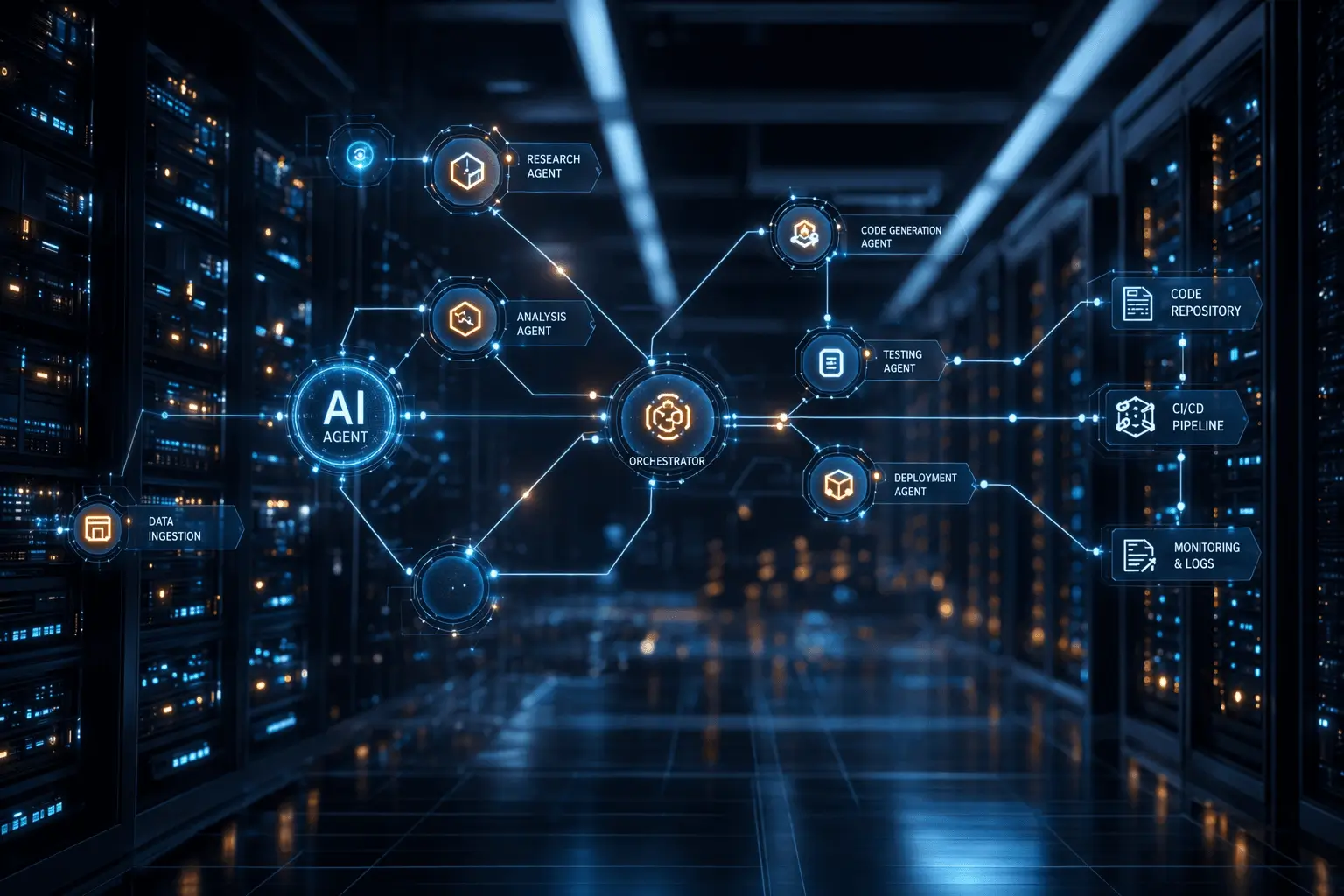
The age of Artificial Intelligence as a purely passive tool, driven by powerhouses like OpenAI, is rapidly coming to an end. We are witnessing the emergence of a powerful new paradigm: AI agents. Unlike the chatbots and large language models (LLMs) of the early 2020s that waited patiently for human prompts, AI agents are autonomous software systems engineered to plan, reason, adapt, and execute multi-step tasks with minimal to no human intervention.
This transition from conversational interfaces to agentic workflows is arguably the most significant technological leap since the advent of cloud computing. In this deep dive, we will explore exactly what AI agents are, the architectural breakthroughs making them possible, their immediate real-world applications, and the profound ways they are restructuring the modern business landscape.
What Are AI Agents? Moving Beyond the Prompt
To understand the magnitude of this shift, one must first understand the limitations of traditional generative AI. If you interact with a standard LLM, the interaction is fundamentally transactional. You provide a prompt, the model generates a response based on its training data, and the interaction ends. The model possesses no memory of the interaction outside of the immediate context window, no ability to interact with the outside world, and no capacity for self-correction.
AI agents, conversely, operate in continuous, dynamic loops. They are designed to act as digital workers rather than digital encyclopedias.
When an AI agent is given a high-level goal - such as “research our top three competitors, summarize their recent product launches, and draft a competitive analysis memo” - it doesn’t just generate a generic response. Instead, it engages in a complex cognitive architecture:
- Task Decomposition: The agent breaks the high-level goal down into manageable subtasks.
- Tool Use: The agent utilizes external tools. It might use a browser API to search the web, a scraper to extract text from competitor websites, and a database connector to query internal sales data.
- Execution and Observation: The agent executes a subtask and observes the result.
- Self-Reflection and Course Correction: If a web search returns irrelevant results, or an API call fails, the agent recognizes the error, adjusts its strategy, and tries a different approach.
- Synthesis: Finally, the agent synthesizes the gathered information into the requested final output.
Think of the difference between asking an intern a question and hiring an experienced project manager. That is the leap from chatbots to agents.
Why Now? The Convergence of Enabling Technologies
The concept of autonomous software agents is not entirely new; it has been a theoretical goal of computer science for decades. However, several critical technological forces have converged in the mid-2020s to make robust, commercially viable AI agents a reality.
The Evolution of Foundation Models
The foundation models powering these agents have become exponentially more sophisticated. Early LLMs struggled with complex reasoning and often suffered from “hallucinations” - confidently presenting false information as fact. The current generation of models has been specifically fine-tuned for logical reasoning, code generation, and step-by-step problem solving. Their ability to maintain context over long, multi-turn interactions is the bedrock upon which agentic workflows are built.
Advanced Tool-Use Capabilities
A brain in a jar cannot change the world. AI models remained limited until developers discovered how to give them “hands.” Modern foundation models are now trained specifically to understand when and how to call external APIs. If an agent needs to know the current weather, it doesn’t guess; it writes a quick script to query a weather API, parses the JSON response, and incorporates the real-time data into its workflow. This capability allows agents to interact with CRMs, ERP systems, email clients, and the broader internet.
The Rise of Orchestration Frameworks
Building an agent from scratch is incredibly complex. However, the open-source community and specialized startups have developed robust orchestration frameworks - such as LangChain, AutoGen, and CrewAI. These frameworks provide the scaffolding required to build agents quickly. They handle the memory management, the tool binding, and the loop execution, allowing developers to focus on the specific business logic.
Unprecedented Enterprise Demand
Finally, the economic environment has created a massive pull for automation. As inflation pressures margins and labor shortages persist in critical sectors, enterprises are desperately seeking ways to scale operations without scaling headcount. The promise of “digital workers” who can operate 24/7 at a fraction of the cost of human labor is an irresistible value proposition.
Real-World Applications: Agents in Production
AI agents are no longer confined to research labs; they are actively being deployed in production environments across various industries, delivering measurable ROI.
Revolutionizing Customer Support
Customer support was the first logical beachhead for AI, fundamentally changing the future of remote work. While early chatbots were widely reviled for their rigid decision trees and inability to solve complex problems, agentic customer support systems represent a massive leap forward.
Modern support agents can access a customer’s account history, cross-reference it with shipping databases, identify a delayed package, proactively issue a partial refund according to company policy, and draft a personalized apology email - all without human intervention. Companies deploying these systems are reporting up to a 40% reduction in escalated support tickets and significantly higher customer satisfaction scores.
The Rise of the AI Software Engineer
Perhaps the most astonishing application of AI agents is within software engineering itself. We are moving beyond “copilots” that suggest lines of code to fully autonomous “software engineer agents.”
Given a GitHub issue describing a bug, these agents can pull the repository, navigate the codebase, identify the source of the bug, write a patch, write the corresponding unit tests, and submit a pull request for human review. While they cannot yet architect complex, greenfield systems from scratch, their ability to handle routine maintenance, refactoring, and bug fixing is supercharging developer productivity.
Financial Automation and Market Response
In the financial sector, latency is the enemy of profit. AI agents are being deployed to monitor global news feeds, ingest real-time market data, and execute complex trading strategies. For instance, an agent might detect a sudden change in global tariff policies by parsing international news, immediately assess the exposure of a specific portfolio to those tariffs, and autonomously execute hedging strategies before human analysts have even finished reading the headline.
Marketing and Sales Optimization
Marketing teams are deploying multi-agent systems to manage entire campaigns. One agent might be responsible for generating creative copy, another for designing a layout using a headless design tool, and a third for analyzing A/B test results and reallocating ad spend in real-time based on conversion metrics. In sales, agents act as hyper-efficient SDRs (Sales Development Representatives), researching prospects, drafting highly personalized outreach emails, and managing follow-up sequences.
The Challenges Ahead: Friction in the Machine
Despite the incredible promise, the deployment of AI agents is not without significant friction. Business leaders must understand the limitations and risks associated with this nascent technology.
The Reliability Problem
The most glaring issue with current AI agents is reliability. Because they operate in loops and make autonomous decisions, a small error early in a workflow can compound into a massive failure by the end. If an agent misinterprets an API response, it might delete a database table instead of updating it. Ensuring that agents fail gracefully and know when to escalate to a human is a critical area of ongoing research.
The Cost of Cognitive Loops
Multi-step reasoning is computationally expensive. Every time an agent reflects on a problem, calls a tool, or evaluates an output, it requires a call to the underlying foundation model. These API costs can spiral out of control quickly. A task that takes a human five minutes might cost several dollars in API credits if an agent gets caught in an inefficient loop. Optimizing agent architecture for cost-efficiency is a major priority for enterprise adoption.
Security and The Expanding Attack Surface
Granting an AI system access to corporate databases, email servers, and cloud infrastructure introduces profound security vulnerabilities. The concept of “prompt injection” - where a malicious user crafts an input designed to hijack the agent’s instructions - is a serious threat. If an agent has the authority to execute code or access sensitive financial data, a successful prompt injection attack could be devastating. Robust sandboxing and strict “least privilege” access controls are mandatory.
The Evaluation Conundrum
How do you measure the performance of an autonomous agent? With traditional software, you write a unit test: given input X, expect output Y. But agents operate in open-ended environments. Measuring their performance requires evaluating not just the final output, but the logic and efficiency of the path they took to get there. The industry is currently lacking standardized benchmarks for agentic performance.
What This Means for Business Strategy
The integration of AI agents is not an IT project; it is a fundamental shift in business strategy. Companies that adopt agentic AI early and thoughtfully will gain structural advantages that will be incredibly difficult for laggards to overcome.
The question isn’t whether AI agents will transform business - it’s whether your organization will be architected to leverage them when they do.
Success requires a deliberate approach. Organizations should begin by identifying high-volume, repetitive processes that require a degree of cognitive flexibility but are currently bottlenecked by human labor. They must invest heavily in data infrastructure - an agent is only as good as the internal data it can access. Most importantly, they must prioritize “human-in-the-loop” architectures, ensuring that agents amplify human potential rather than operating entirely in the dark. For an excellent perspective on how these technological shifts mirror broader historical trends, you can read more about stochastic processes and predictability.
Looking Ahead: The Era of Multi-Agent Systems
We are currently in the single-agent era. The next evolutionary step is the widespread deployment of multi-agent systems. Imagine a corporate environment where a “Research Agent,” a “Financial Analysis Agent,” and a “Strategy Agent” collaborate, debate, and verify each other’s work to produce a comprehensive merger and acquisition proposal.
These systems will become increasingly specialized, with different agents fine-tuned for specific industries, regulatory environments, and corporate cultures. The technological landscape is inherently unpredictable. The stochastic nature of AI development guarantees that there will be unexpected breakthroughs and unforeseen challenges.
However, the trajectory is clear. The shift from software as a tool to software as a proactive agent represents a fundamental reordering of how work is accomplished. We will continue tracking the most important developments in agentic AI throughout the year, dissecting the noise to bring you the strategies that matter.