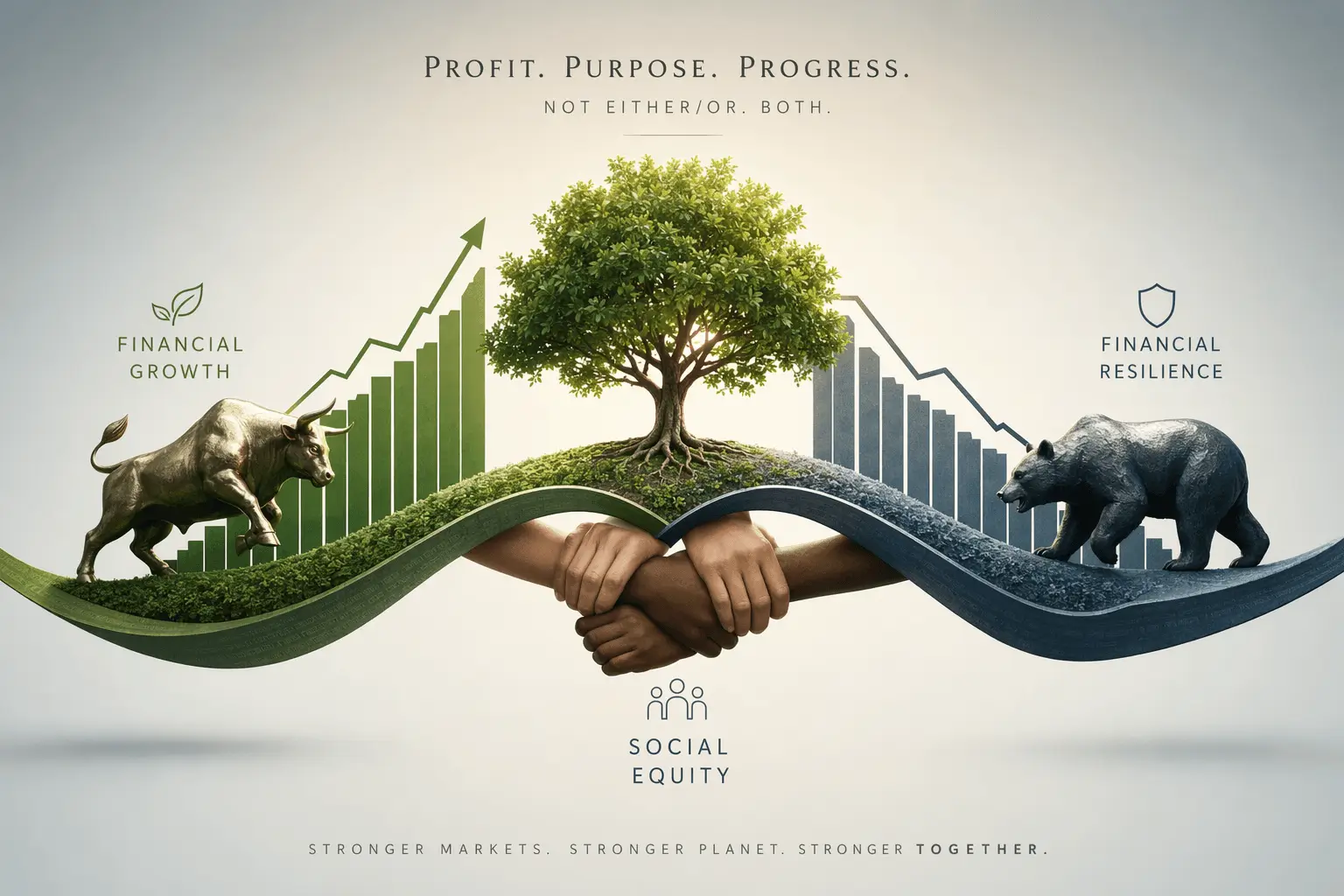
For decades, the doctrine of shareholder primacy reigned supreme in the financial markets. The sole responsibility of a corporation, famously articulated by economist Milton Friedman, was to increase its profits. Environmental impact and social welfare were considered “externalities” - issues for governments and philanthropists to worry about, not Wall Street.
Today, that orthodoxy has been fundamentally shattered. The integration of Environmental, Social, and Governance (ESG) criteria into investment decisions is arguably the most significant shift in capital markets since the invention of the mutual fund. ESG is no longer a niche strategy for “ethical” investors; it is a multi-trillion-dollar juggernaut that dictates how the world’s largest asset managers allocate capital.
However, the rise of ESG has not been smooth. It is currently caught in a massive ideological and regulatory crossfire. Proponents argue it is the only way to save capitalism from its own short-termism, while critics dismiss it as “woke capitalism” or sophisticated greenwashing. In this deep dive, we will unpack the mechanics of ESG scoring, the validity of the political backlash, the chaotic regulatory landscape, and why the core principles of ESG are likely to survive the current controversy.
Deconstructing the Acronym: What Does ESG Actually Measure?
The primary confusion surrounding ESG stems from the fact that it attempts to compress incredibly complex, qualitative realities into a single, quantitative financial score.
Environmental (E): The Physical and Transition Risks
The “E” is the most rigorously defined pillar. It measures a company’s impact on the natural world, but more importantly for investors, it measures the natural world’s impact on the company.
Investors are evaluating two types of climate risk. The first is physical risk: If a company’s primary manufacturing facility is located on a coastline vulnerable to rising sea levels, that is a direct financial liability. The second is transition risk: As the world moves toward massive investments in climate tech and deep decarbonization, companies heavily reliant on fossil fuels risk possessing “stranded assets.” A coal company’s reserves are worthless if governments globally ban the burning of coal. An excellent ESG score indicates a company is proactively adapting to a low-carbon economy.
Social (S): The Complexity of Human Capital
The “S” is far more subjective and difficult to quantify. It evaluates how a company manages its relationships with employees, suppliers, customers, and the communities where it operates.
This encompasses everything from workplace diversity and inclusion metrics to data privacy practices (a critical factor for tech companies navigating the ethics of data monetization). Crucially, it also examines supply chain labor practices. The rise of platform cooperativism and gig worker rights is a direct reflection of changing societal expectations regarding fair labor. An investor utilizing “S” criteria argues that a company with a high turnover rate and a history of labor strikes is a riskier, less profitable long-term investment than a company with high employee satisfaction.
Governance (G): The Foundation of Corporate Trust
The “G” is the oldest and most universally accepted pillar. It deals with a company’s leadership, executive pay, audits, internal controls, and shareholder rights.
Investors look for diverse boards of directors, transparent accounting practices, and compensation structures that align executive incentives with long-term shareholder value rather than short-term stock bumps. A company with poor governance - perhaps characterized by a CEO with unchecked power and opaque lobbying activities - is viewed as highly susceptible to scandal and financial ruin.
The Trillion-Dollar Catalyst and The Greenwashing Crisis
The exponential growth of ESG was largely catalyzed by massive institutional investors. When firms like BlackRock, the world’s largest asset manager, announced they would put sustainability at the center of their investment approach, trillions of dollars shifted direction.
The Illusion of “Sustainable” Funds
This massive influx of capital created a perverse incentive. Asset managers realized that simply slapping the label “ESG” or “Sustainable” onto a mutual fund allowed them to attract massive inflows of capital and charge higher management fees.
This led to the current crisis of “greenwashing.” Investigations frequently reveal that highly rated “ESG funds” hold significant positions in fossil fuel companies, fast-fashion retailers with horrific labor practices, and defense contractors. The rating agencies that assign these ESG scores (like MSCI or Sustainalytics) use highly divergent, proprietary methodologies. A company might be rated “AAA” by one agency and “Average” by another, making it nearly impossible for a retail investor to know what they are actually buying.
Single vs. Double Materiality
The core of the greenwashing confusion lies in a misunderstanding of what the rating agencies are actually measuring. In the United States, ESG ratings generally measure single materiality: how the changing environment and society will impact the company’s bottom line. They do not necessarily measure the company’s impact on the world. Therefore, a massive oil company can receive a high ESG score if it has strong governance and is effectively managing the financial risks of climate change, regardless of how much carbon it emits.
In contrast, the European Union is pushing for double materiality: requiring companies to report both how climate change affects their finances, and how their operations affect the climate. This philosophical divide is causing massive friction in global markets.
The Political Backlash: “Woke Capitalism” vs. Fiduciary Duty
As ESG has grown in power, it has inevitably become deeply politicized, particularly in the United States.
The Anti-ESG Movement
A coordinated political movement has emerged, arguing that asset managers prioritizing ESG factors are violating their fiduciary duty to maximize financial returns. Several US states have passed legislation banning state pension funds from investing with asset managers who “boycott” the fossil fuel or firearms industries.
Critics argue that ESG allows unelected Wall Street executives to impose progressive social policies on the rest of the country through the backdoor of capital allocation, bypassing the democratic legislative process. They argue that if society wants to reduce carbon emissions, the government should pass a carbon tax, rather than relying on BlackRock to choke off capital to oil companies.
The Investor Rebuttal
The rebuttal from institutional investors is purely capitalist: climate risk is investment risk. They argue they are not trying to save the polar bears; they are trying to protect their clients’ portfolios from the inevitable economic disruptions of the 21st century. Ignoring the physical risks of extreme weather or the regulatory risks of impending carbon taxes is, in their view, a profound failure of fiduciary duty.
The Regulatory Reckoning
The Wild West era of ESG is ending. Regulators are stepping in to standardize definitions, punish greenwashing, and enforce mandatory disclosures.
The SEC and Standardized Disclosure
In the United States, the Securities and Exchange Commission (SEC) has proposed sweeping new rules that would require publicly traded companies to disclose their greenhouse gas emissions and the specific climate-related risks facing their business. This moves ESG data from the realm of voluntary marketing brochures to strictly audited financial filings, carrying the threat of severe legal liability for inaccurate reporting.
The EU Taxonomy
The European Union has gone much further, developing a highly complex “Taxonomy” - a rigorous, science-based classification system defining exactly which economic activities can be considered environmentally sustainable. This is designed to eliminate greenwashing entirely by forcing asset managers to prove, using strict criteria, that a fund labeled “green” is actually funding the energy transition.
Conclusion: The Future of Value Assessment
The acronym “ESG” may not survive the current political and regulatory firestorm. It has become too polarizing, too broad, and too easily manipulated. However, the underlying principles that ESG attempted to codify are permanent additions to the financial landscape.
We are transitioning to an era of “Integrated Accounting.” In the future, investors will not view a company’s carbon emissions, employee turnover rate, and board diversity as “alternative” data points. They will view them as fundamental financial metrics, just as important as quarterly revenue or debt-to-equity ratios.
The companies that thrive in the 2020s and beyond will be those that realize long-term profitability is inextricably linked to environmental resilience and social stability. The era of ignoring the externalities is over; the market is finally pricing them in.