When companies like Uber, TaskRabbit, and Deliveroo first emerged in the early 2010s, they promised a revolution in how we work. The pitch was intoxicating: “Be your own boss,” “Set your own hours,” and “Turn your spare time into cash.” The “Gig Economy” was hailed as the ultimate triumph of technology over rigid corporate bureaucracy, offering unprecedented flexibility for the modern worker.
A decade later, the reality of the Gig Economy 1.0 looks drastically different. While the convenience for consumers is undeniable, the economic reality for the workers has steadily deteriorated. Squeezed by opaque algorithms, classification battles over their status as “independent contractors,” and constantly shifting pay structures, many gig workers find themselves trapped in a cycle of digital piecework with no safety net.
However, a new economic model is emerging to challenge the dominance of these Silicon Valley monopolies. It is called “Platform Cooperativism,” and it represents the Gig Economy 2.0. In this deep dive, we will explore the structural flaws of the current gig model, the radical concept of worker-owned apps, the technological tools making this possible, and the immense business challenges these cooperatives face in scaling against heavily funded incumbents.
The Flaws of Gig Economy 1.0: Algorithmic Management
To understand the appeal of platform cooperativism, we must first dissect the failure of the traditional gig model from the perspective of labor. The core issue is not necessarily the app-based nature of the work, but the ownership structure of the app itself.
The Value Extraction Machine
Companies like Uber and DoorDash operate as massive, centralized intermediaries. They connect a buyer (a rider or a diner) with a seller (a driver or a courier). For providing this digital matchmaking service, the platform extracts a significant “take rate” - often 20% to 30% of the total transaction.
Because these companies are backed by venture capital and beholden to public shareholders, their primary legal and fiduciary duty is to maximize profits for their investors, not to maximize wages for their drivers. When the platform is forced to show profitability, the easiest lever to pull is often reducing worker compensation or increasing consumer prices, maximizing the spread.
Algorithmic Subordination
Furthermore, while gig workers are legally classified as “independent contractors” - meaning they do not receive health insurance, paid time off, or minimum wage guarantees - they are heavily managed by the platform’s algorithm.
The algorithm dictates which jobs they are offered, determines their pay rate in real-time based on opaque dynamic pricing models, and can instantly “deactivate” (fire) them based on automated customer ratings without a human appeals process. This phenomenon, known as “algorithmic subordination,” creates a class of workers who bear all the risks of entrepreneurship with none of the actual autonomy. The International Labour Organization (ILO) has repeatedly raised concerns about how this structure erodes traditional labor protections globally.
Enter Platform Cooperativism
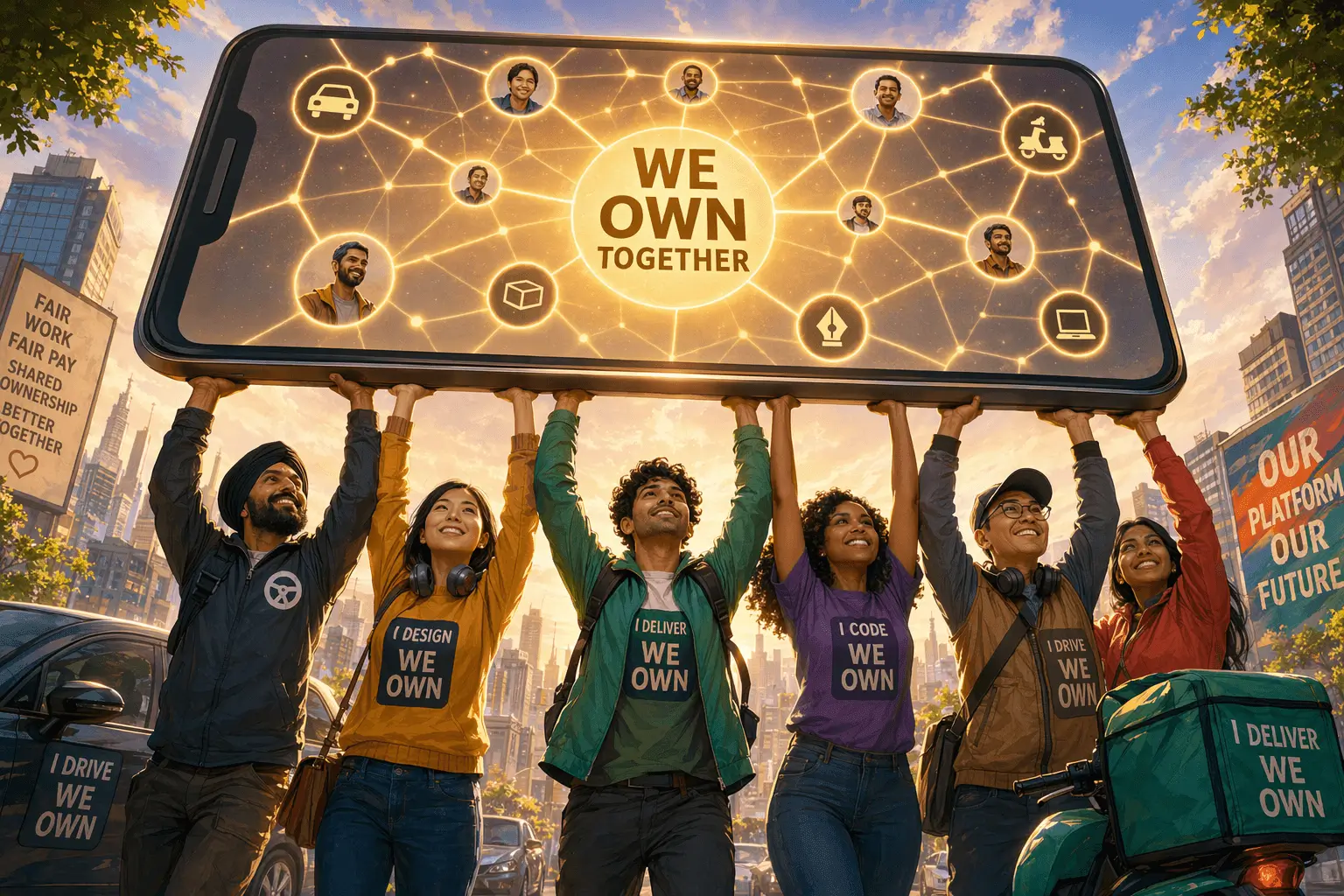
Platform Cooperativism asks a simple but radical question: What if the app was owned and governed by the people who rely on it for their livelihood?
The Cooperative Heritage, Digitized
The cooperative business model is not new. Agricultural co-ops, credit unions, and worker-owned grocery stores have existed for over a century. A cooperative is simply an enterprise jointly owned and democratically controlled by its members to meet their common economic needs.
Platform cooperativism simply applies this ancient model to the digital economy. Instead of a tech platform being owned by venture capitalists in Silicon Valley, it is owned by the drivers in New York, the cleaners in London, or the freelance designers in Berlin. Organizations like the Platform Cooperativism Consortium (PCC) are actively working to build the legal and technical frameworks to support these endeavors globally.
Democratic Governance and Fair Pay
In a platform co-op, the extractive “take rate” is fundamentally altered. Because the workers are the shareholders, there is no mandate to extract a 30% profit margin to pay back distant investors. The platform only needs to take enough of a cut to cover its operating costs (server fees, marketing, app maintenance).
Any surplus profit generated at the end of the year is distributed back to the workers as a dividend, based on how much labor they contributed to the platform. Furthermore, the workers elect the board of directors and have a democratic vote on major changes to the algorithm, pricing structures, and community guidelines.
The Intersection with Web3 and the Creator Economy
The concept of distributed ownership is gaining significant traction due to parallel developments in other tech sectors, most notably Web3 and the broader creator economy.
Web3 and Decentralized Autonomous Organizations (DAOs)
As we explored in our piece on Decentralized Finance (DeFi), blockchain technology allows for trustless, decentralized coordination. Platform co-ops are increasingly looking at DAOs (Decentralized Autonomous Organizations) as a governance structure.
By issuing digital tokens to workers, a platform can automate profit-sharing via smart contracts. If a driver completes a ride, a micro-fraction of a governance token is automatically deposited into their digital wallet. This token represents both their equity in the network and their voting power. This provides a technically elegant way to manage ownership among thousands of distributed, transient gig workers.
Lessons from the Creator Economy
The push for platform cooperativism mirrors the dynamics we see in the financial evolution of the creator economy. Just as YouTubers and Substack writers are desperately trying to “own their audience” rather than renting it from an algorithm, gig workers are trying to own their customer relationships. The desire for autonomy and equity is a defining economic theme of the 2020s labor market.
The Brutal Reality: Challenges to Scaling
While the moral and economic arguments for platform cooperativism are compelling, the practical business challenges are immense. Building a worker-owned app is easy; competing against a heavily entrenched monopoly is extraordinarily difficult.
The Capital Chasm
The traditional gig giants achieved market dominance by burning billions of dollars of venture capital to artificially lower consumer prices and subsidize driver pay, thereby capturing market share. This is the “blitzscaling” playbook.
A platform co-op, by definition, cannot take traditional venture capital without giving up worker control. This means they are chronically underfunded. They cannot afford to run massive Super Bowl ad campaigns or offer consumers $20 promo codes for their first ride. They must rely on organic, grassroots growth, which is painfully slow in a market where consumers are highly price-sensitive and addicted to convenience.
The “Chicken and Egg” Network Effect
Two-sided marketplaces (like ride-hailing or food delivery) require massive network effects to function. A rider won’t use the app if there are no drivers available, and a driver won’t turn on the app if there are no riders requesting trips.
Traditional gig companies solved this by literally paying drivers to drive empty cars until the rider demand caught up. Co-ops do not have the cash reserves to subsidize this initial bootstrapping phase. Consequently, successful platform co-ops tend to be highly localized - focusing on a single city or a very specific niche (like a courier co-op specifically for delivering medical supplies) - rather than attempting rapid global expansion.
Case Studies in Co-op Success
Despite these challenges, several platform co-ops are proving the model viable.
- The Drivers Cooperative (New York City): A ride-hailing app owned entirely by its drivers. By eliminating the corporate overhead and profit margins of its competitors, it claims to pay drivers significantly more per trip while simultaneously offering slightly lower fares to riders. It has grown to thousands of drivers by leveraging community organizing and appealing to socially conscious consumers.
- Up&Go: A platform for professional home cleaning services. The cleaners own the platform, set their own rates, and keep 95% of the revenue they generate, with the remaining 5% covering the platform’s maintenance costs.
Conclusion: A More Equitable Digital Future
The Gig Economy 1.0 proved that the technology to coordinate distributed labor at scale works flawlessly. However, it also proved that applying a hyper-capitalist, venture-backed ownership model to that technology results in severe labor exploitation.
Platform Cooperativism represents a vital course correction. It suggests that the future of work doesn’t have to be a race to the bottom dictated by an invisible algorithm. By merging the ancient concept of cooperative ownership with cutting-edge digital platforms (and potentially Web3 governance structures), gig workers can reclaim their agency and build sustainable, equitable businesses.
The transition will not be fast, and co-ops will likely struggle to match the sheer scale of the legacy tech giants. But for millions of gig workers globally, the Gig Economy 2.0 offers something far more valuable than a “side hustle” - it offers a genuine stake in the digital economy they helped build.