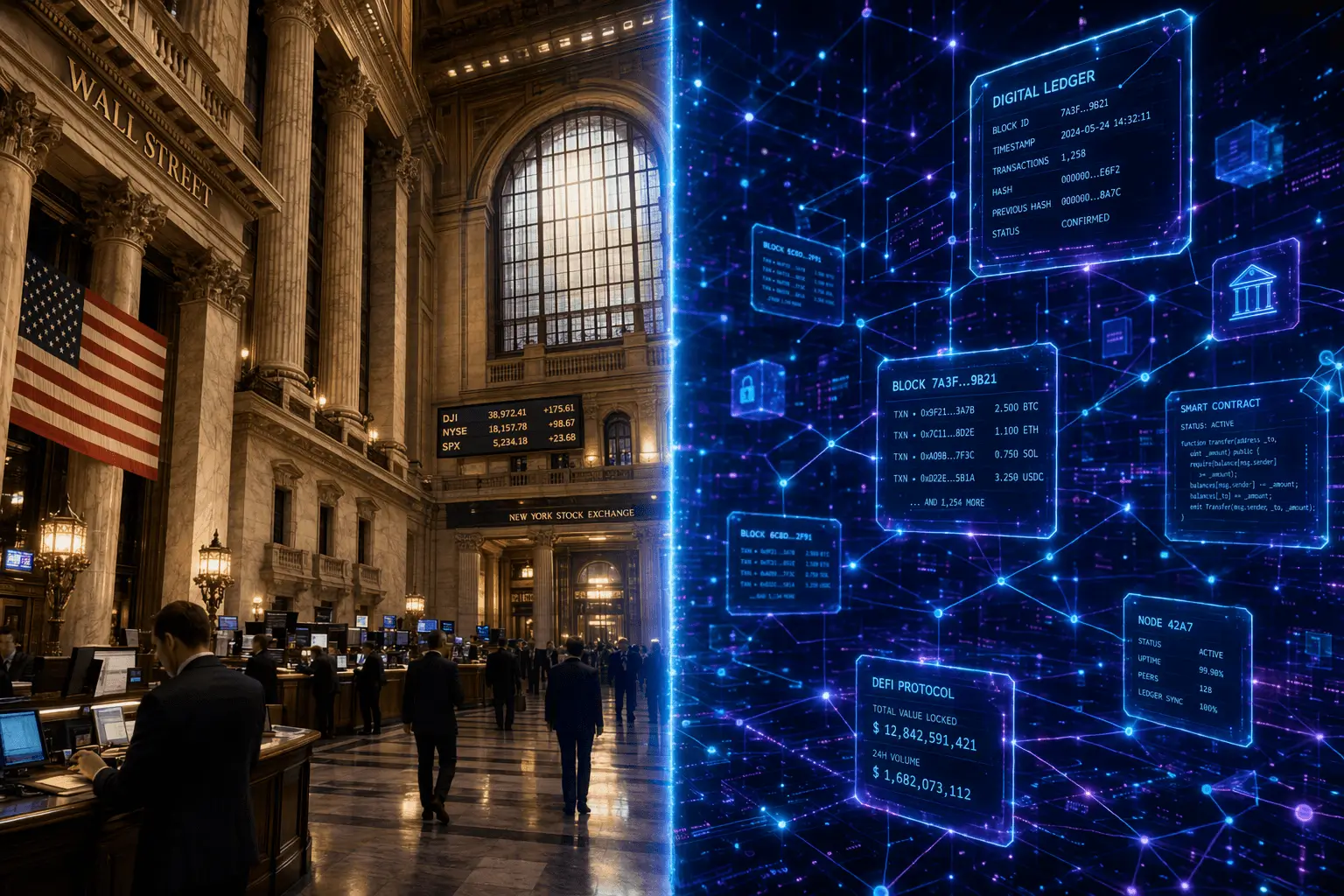
For centuries, the global financial system has operated on a foundation of centralized trust. Banks, clearinghouses, brokerages, and central authorities have acted as the indispensable intermediaries of commerce, holding our money, facilitating our transactions, and dictating the terms of our economic participation. Today, this entrenched system faces an existential challenge from an entirely different architecture: Decentralized Finance, or DeFi.
DeFi represents a paradigm shift. It replaces the marbled halls of traditional banking with open-source code and smart contracts deployed on blockchain networks. By stripping away intermediaries, DeFi promises a more inclusive, efficient, and transparent financial ecosystem. However, it also introduces unprecedented risks, volatile asset dynamics, and a regulatory nightmare. As traditional institutions begin to tentatively bridge the gap to this new world, the collision between these two systems is redefining the future of money.
The Architecture of Traditional Banking
To understand the disruption DeFi brings, we must first examine the mechanics of the legacy system it seeks to replace. Traditional finance (TradFi) is hierarchical and siloed.
Intermediaries and Friction
When you send money internationally, the transaction does not simply go from your bank to the recipient’s bank. It often passes through a complex web of correspondent banks, clearing networks like SWIFT, and central bank ledgers. Each intermediary takes a cut, and each hop introduces latency. A wire transfer can take days to settle, especially across borders, and can cost a significant percentage of the total transaction value.
The Moat of Regulation and Trust
The primary commodity of a traditional bank is not money, but trust. Because they hold custody of customer assets, banks are heavily regulated. They are subject to capital requirements, anti-money laundering (AML) laws, and strict “Know Your Customer” (KYC) regulations. This regulatory moat makes banking incredibly difficult to disrupt from the outside, as launching a new bank requires massive capital and legal compliance.
However, this reliance on centralized trust has its drawbacks. Banks are opaque; their internal ledgers are closed to the public. They can arbitrarily deny service, freeze accounts, or collapse entirely due to poor risk management, as witnessed during the 2008 financial crisis and the regional banking failures of the early 2020s.
The Promise of Decentralized Finance
DeFi seeks to recreate the entire financial stack - lending, borrowing, trading, and derivatives - without the centralized intermediaries. It relies primarily on Ethereum and other smart-contract-enabled blockchains to execute financial agreements automatically and immutably.
Programmable Money and Smart Contracts
At the heart of DeFi are smart contracts: self-executing lines of code stored on a blockchain that automatically enforce the terms of an agreement. When you use a DeFi lending protocol like Aave or Compound, you are not handing your money to a loan officer. You are locking your digital assets into a smart contract that algorithmically pairs you with a borrower, sets the interest rate based on supply and demand, and liquidates the borrower’s collateral automatically if they default.
This automation removes human error, bias, and overhead. It enables a global, 24/7 financial market where trades settle in seconds, rather than days. Furthermore, DeFi is permissionless; anyone with an internet connection and a digital wallet can participate, theoretically “banking the unbanked” populations of the world.
Composability: The “Money Legos”
One of the most powerful aspects of DeFi is its “composability.” Because DeFi protocols are built on open-source code, they can be plugged into one another like Lego bricks. A developer can build an application that utilizes a decentralized exchange (DEX) like Uniswap for trading, integrates a lending protocol for yield, and uses an algorithmic stablecoin for stability - all within a single, seamless user interface.
This composability leads to rapid, permissionless innovation. It allows the ecosystem to evolve at a blistering pace, creating complex financial instruments that would take years to develop in the traditional banking sector.
The Inherent Risks of the DeFi Ecosystem
While the promises of DeFi are revolutionary, the reality is fraught with immense risk. The lack of centralized oversight means that users operate in a “Wild West” environment where caveat emptor (buyer beware) is the only rule.
Smart Contract Vulnerabilities
The greatest strength of DeFi is also its greatest weakness. Smart contracts are written by humans, and human code is prone to errors. A single bug or logical flaw in a smart contract can be exploited by hackers to drain millions of dollars from a protocol in seconds. Unlike a traditional bank robbery, which is limited by physical constraints, a smart contract exploit can be executed anonymously from anywhere in the world. As we have seen with the urgent need to address quantum computing’s threat to modern cybersecurity, the underlying cryptographic security of these networks is in a constant arms race against highly sophisticated adversaries.
The Oracle Problem
DeFi protocols often need data from the outside world, such as the real-time price of an asset, to execute smart contracts (e.g., determining if a loan is undercollateralized). This data is provided by “oracles.” If an oracle is manipulated or fails to provide accurate data, the smart contract can execute incorrectly, leading to massive, cascading liquidations.
Regulatory Uncertainty and the Shadow Banking Parallel
Currently, much of DeFi operates in a regulatory gray area. Because there is no centralized entity to regulate, governments struggle to apply traditional AML and KYC laws to decentralized protocols. This makes DeFi attractive for illicit finance, though the transparent nature of blockchain ledgers also makes it easier for law enforcement to track the flow of funds post-incident.
Critics argue that DeFi, in its current state, resembles the “shadow banking” system that precipitated the 2008 financial crisis - highly leveraged, deeply interconnected, and operating without the safety nets of central bank liquidity or deposit insurance. If a major DeFi protocol collapses, there is no centralized bailout mechanism.
The Convergence: TradFi Meets DeFi
Despite the ideological differences, traditional banking and decentralized finance are not destined to remain completely separate. A convergence is underway, driven by institutional demand for the efficiencies of blockchain technology and the DeFi ecosystem’s need for legitimacy and institutional capital.
Tokenization of Real-World Assets (RWAs)
One of the most significant bridges between these two worlds is the tokenization of real-world assets. Traditional financial instruments - such as real estate, government bonds, and corporate debt - are being represented as digital tokens on a blockchain.
By tokenizing these assets, traditional banks can leverage the speed, transparency, and fractionalization benefits of DeFi. A commercial real estate property can be tokenized and traded globally 24/7 with instant settlement, bypassing the cumbersome legacy systems of deed transfers and title insurance. This trend is closely linked to how other industries are adopting blockchain, similar to how supply chain logistics are being revolutionized by blockchain technology.
Institutional Adoption and Permissioned DeFi
Major financial institutions like JPMorgan, Goldman Sachs, and BlackRock are actively exploring blockchain technology. However, they are generally unwilling to operate in the permissionless, anonymous environment of public DeFi protocols.
Instead, we are seeing the rise of “permissioned DeFi” - platforms that utilize the architecture of smart contracts but require users to undergo KYC verification before participating. This provides the efficiency of decentralized technology while satisfying the regulatory requirements of institutional capital.
The Macroeconomic Implications
The ongoing evolution and integration of DeFi will have profound macroeconomic consequences, potentially reshaping how global capital is allocated.
Disintermediation and Bank Revenue
If DeFi continues to gain traction, traditional banks face the threat of severe disintermediation. The highly lucrative business of acting as a middleman for payments, currency exchange, and lending will be steadily eroded by algorithmic protocols that perform the same functions for a fraction of the cost. Banks must adapt by transitioning from intermediaries to specialized service providers, focusing on complex advisory roles, secure custody of digital assets, and institutional risk management.
The Democratization of Yield
In the traditional financial system, access to high-yield investment opportunities is often restricted to accredited investors or massive hedge funds. Retail investors are largely confined to low-interest savings accounts or traditional equities.
DeFi democratizes access to yield. Anyone with a digital wallet can provide liquidity to a decentralized exchange or lend their assets to earn interest rates that often dwarf those offered by traditional banks. While this comes with substantially higher risk, it represents a fundamental shift in the democratization of capital markets.
Conclusion: The Financial Infrastructure of the Future
The collision between Decentralized Finance and Traditional Banking is not a zero-sum game. It is highly unlikely that DeFi will completely eradicate the traditional banking sector, nor will traditional banks be able to ignore the technological advancements of blockchain indefinitely.
Instead, the financial infrastructure of the future will be a hybrid. We will see a financial system where the front-end user experience and regulatory compliance are handled by trusted, recognizable institutions, while the back-end settlement, clearing, and asset transfer are executed flawlessly by decentralized, open-source smart contracts.
The transition will be volatile, marked by spectacular failures, regulatory crackdowns, and rapid innovation. But the underlying trajectory is clear: the global financial system is being re-platformed. The age of the centralized intermediary is slowly giving way to the age of the algorithmic protocol. For businesses, investors, and consumers, understanding and adapting to this systemic shift is the defining financial challenge of the decade.