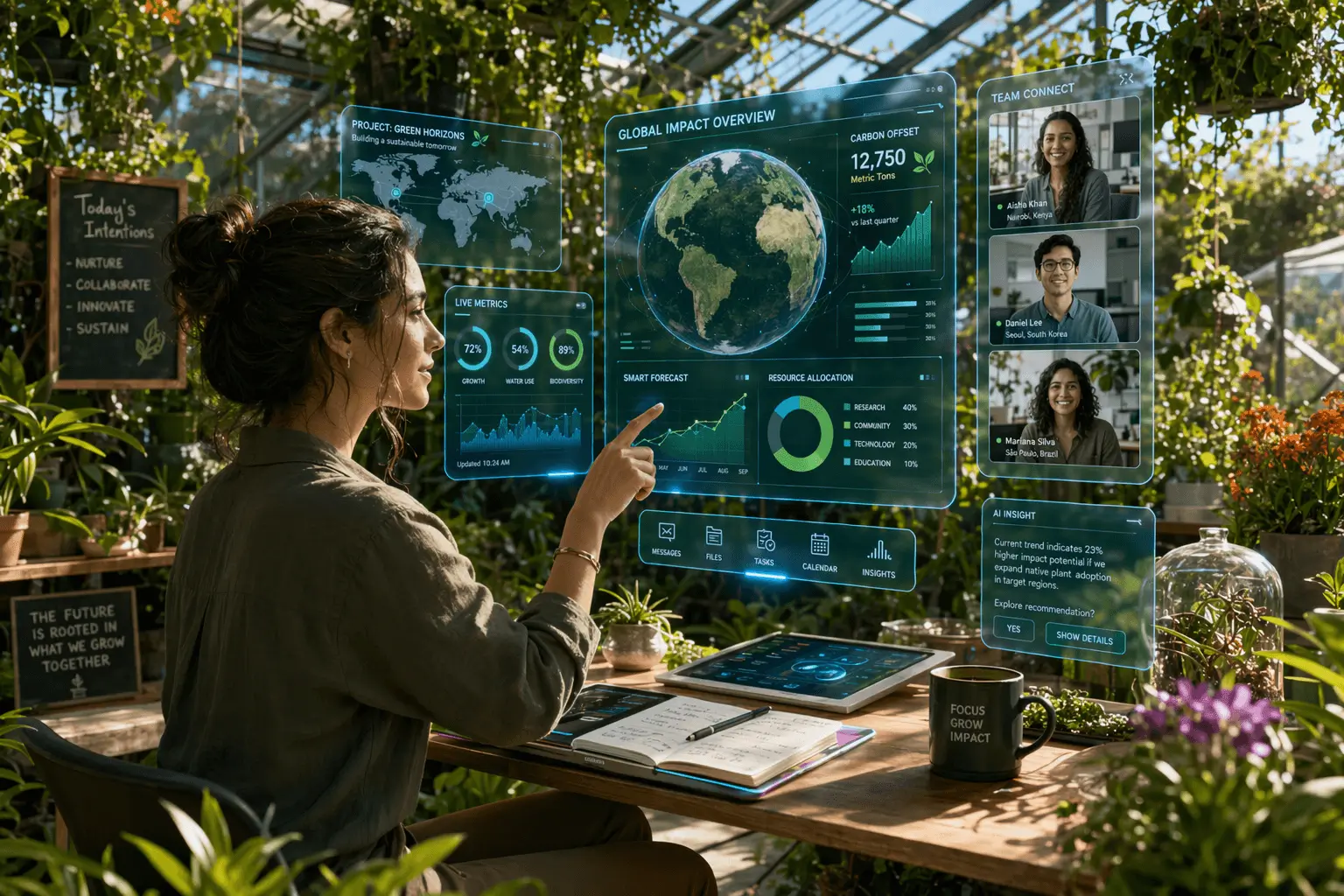
When the global pandemic forced the world into an impromptu work-from-home experiment in 2020, the immediate response was functional, not visionary. Businesses scrambled to replicate the physical office in a digital environment. We traded conference room tables for Zoom grids and watercooler chats for Slack channels. This rapid digitization kept the global economy afloat, but it also exposed the fundamental flaws of simply copy-pasting synchronous office routines into a distributed model.
Today, as we look toward the latter half of the 2020s, the conversation has fundamentally shifted. The debate is no longer about whether remote work is here to stay, but how it will evolve. The initial phase of remote work - characterized by “Zoom fatigue,” constant notifications, and blurred boundaries between home and office - is giving way to a more intentional, sophisticated paradigm. The future of remote work extends far beyond the basic tools of video conferencing and instant messaging; it is about restructuring how, when, and where value is created.
The Problem with Synchronous Remote Work
To understand the future, we must first diagnose the present. The predominant model of remote work today relies heavily on synchronous communication. Teams are expected to be online and available during set hours, responding to messages instantaneously and attending back-to-back virtual meetings.
The Illusion of Productivity
Synchronous remote work creates an illusion of productivity. A calendar full of meetings feels like work, but it often leaves little time for actual deep, focused execution. The cognitive load of constant context-switching - jumping from an email to a Slack thread to a video call - severely degrades an employee’s ability to engage in complex problem-solving.
Furthermore, synchronous models are highly restrictive for global, distributed teams. When a company spans multiple time zones, forcing everyone to align their schedules for a live meeting often results in someone working at an unreasonable hour, leading to burnout and resentment.
The Rise of Asynchronous Collaboration
The antidote to the synchronous trap is asynchronous (async) communication. In an async model, work does not happen in real-time. Information is documented and shared, and colleagues respond when it is optimal for them, within agreed-upon SLAs (Service Level Agreements).
Companies that have mastered async work - such as GitLab or Automattic - operate on the principle that “if it’s not documented, it doesn’t exist.” This requires a profound cultural shift. It means relying heavily on written memos, project management software, and recorded video updates rather than live meetings. Async work empowers employees to design their own schedules, prioritizing deep work over performative availability. It is a critical component for companies looking to mitigate the disruptions caused by things like global tariff shifts and market impacts, as async teams are naturally more resilient and globally adaptable.
The Next Generation of Collaboration Tools
While Slack and Zoom were the heroes of the initial remote work transition, they are increasingly seen as the baseline rather than the frontier. A new ecosystem of tools is emerging, designed specifically for distributed, asynchronous, and highly complex workflows.
Virtual Headquarters and the Metaverse
One of the challenges of remote work is the loss of spatial awareness and serendipitous interactions. To solve this, companies are experimenting with “virtual headquarters.” Platforms like Gather or Teamflow create 2D or 3D digital environments where employees are represented by avatars. You can “walk” up to a colleague’s desk to initiate a spatial audio chat or gather in a digital cafeteria.
While some view these platforms as gimmicky, they represent an early step toward utilizing the metaverse for enterprise applications. As Augmented Reality and Virtual Reality hardware becomes lighter, more powerful, and cheaper, the concept of a shared digital workspace will become more immersive. Imagine conducting a product design review where a globally distributed team can interact with a 3D holographic model in real-time.
AI Agents and Workflow Automation
Perhaps the most significant technological driver of the next phase of remote work is Artificial Intelligence. We are moving beyond simple automation (like Zapier routing an email to a Slack channel) into the era of autonomous AI.
As explored in our analysis of how AI agents are reshaping business, these intelligent systems can act as personalized digital assistants. An AI agent could analyze a team’s async documentation, summarize key decisions, draft initial project plans, and even manage scheduling. By offloading routine cognitive tasks to AI, human workers are freed to focus on creative, strategic, and high-empathy work.
The Cultural Paradigm Shift
Technology is only half the equation. The most difficult aspect of evolving remote work is managing the necessary cultural transformation. A company can deploy the most advanced async tools in the world, but if leadership still judges performance based on “time in seat” rather than output, the transition will fail.
From Input to Output-Based Management
The traditional office environment relies heavily on visual management - if a manager sees an employee at their desk typing, they assume work is being done. In a distributed environment, this crutch is removed.
Managers must transition to output-based management. This means setting crystal clear goals, defining what success looks like, and then giving employees the autonomy to achieve those goals on their own terms. It requires a high-trust culture where micro-management is explicitly discouraged. Performance reviews must shift from evaluating “hustle” and visibility to measuring actual business impact.
Redefining Onboarding and Company Culture
How do you build a cohesive company culture when employees never meet in person? This is the existential question for remote-first companies. Culture can no longer be defined by ping-pong tables in the breakroom or Friday happy hours.
Instead, culture must be codified in how the company operates. It is defined by the transparency of decision-making, the quality of internal documentation, the respect for boundaries, and the intentional design of virtual retreats. Remote-first onboarding must be meticulous, ensuring new hires immediately understand the communication norms and have access to the knowledge base they need to succeed. Furthermore, many distributed companies are investing heavily in bi-annual or annual physical retreats - flying the entire company to a single location for a week of intensive, purely social bonding to build the trust necessary for remote work to function smoothly.
The Economic Implications of a Distributed Workforce
The shift toward sophisticated remote work has massive macroeconomic implications, altering everything from real estate markets to global talent distribution.
The Unbundling of Geography and Salary
Historically, access to high-paying jobs was geographically restricted. To work in tech, you generally had to live in Silicon Valley, Seattle, or New York. To work in finance, London or Wall Street. This concentration drove up the cost of living and created deep regional inequalities.
Remote work unbundles geography from opportunity. A brilliant software engineer in Lagos or a marketing strategist in Buenos Aires can now compete for the same roles as someone in San Francisco. This global equalization of talent is highly deflationary for salaries in high-cost tech hubs, while simultaneously injecting capital into emerging markets. However, it also means that workers in developed nations are now competing against a truly global talent pool.
The Evolution of the Office
The physical office is not dead, but its purpose is changing drastically. The era of commuting an hour each way just to sit in front of a computer in a cubicle is over. Instead, physical offices are transforming into “collaboration hubs.”
Companies are reducing their overall real estate footprints but investing more heavily in the quality of the space they retain. These new offices are designed specifically for the activities that are difficult to replicate remotely: complex whiteboarding sessions, client entertaining, and team-building offsites. The office is becoming an offsite destination rather than a daily requirement.
Conclusion: The Intentional Enterprise
The future of remote work is not a retreat from the physical world, but a more intentional integration of digital and physical realities. The companies that thrive in the coming decade will be those that view remote work not as an HR accommodation, but as a core operational strategy.
By moving beyond the simplistic tools of the pandemic era, embracing asynchronous workflows, leveraging AI agents, and fostering high-trust cultures, businesses can unlock levels of productivity, global reach, and employee satisfaction that were impossible under the old office-centric model. We are no longer just working from home; we are building the intentional enterprise.