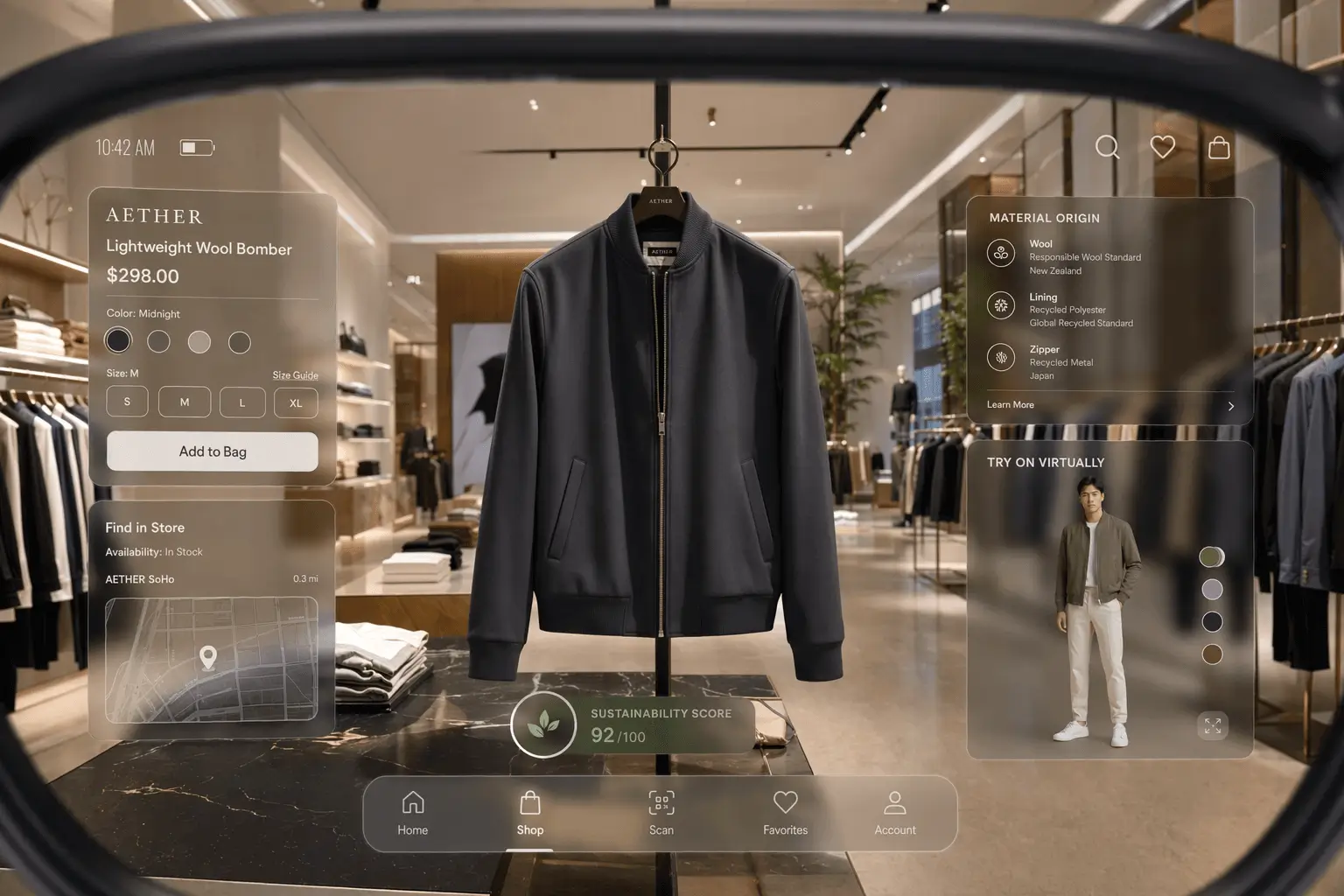
For the past twenty years, the retail industry has been defined by a brutal, seemingly zero-sum war between brick-and-mortar stores and e-commerce giants. E-commerce offered infinite selection, algorithm-driven personalization, and ultimate convenience. Physical retail, on the other hand, offered immediate gratification, tactile engagement, and the social experience of shopping.
The prevailing narrative was that e-commerce would eventually swallow physical retail whole. However, the reality of the 2020s has proven more nuanced. Customer acquisition costs for pure-play digital brands have skyrocketed, while legacy retailers with massive physical footprints have struggled to modernize their legacy systems. The solution to this impasse is not the victory of one channel over the other, but the complete convergence of the two.
The technological catalyst for this convergence is Augmented Reality (AR). By overlaying digital information onto the physical world, AR is transforming how consumers discover, evaluate, and purchase products. This is no longer a gimmick reserved for Snapchat filters; it is a fundamental rewiring of the retail paradigm, offering unprecedented opportunities for brands to increase conversion rates, reduce returns, and build deeper customer loyalty.
The Evolution of AR Hardware and Software
To understand why AR is suddenly a critical retail strategy, we must first look at the technological leaps that have occurred in recent years. Early AR experiences were often clunky, requiring users to download specialized, poorly optimized apps to view jittery, low-resolution 3D models.
The Shift to WebAR
The most significant friction point in early AR retail was the “app download barrier.” Consumers are highly reluctant to download a new app simply to view a piece of furniture in their living room. The industry solved this with the widespread adoption of WebAR. Modern smartphone browsers now natively support complex AR environments. A consumer can simply tap a link on a product page or scan a QR code in a store, and instantly view a high-fidelity 3D model anchored to their physical space, entirely within the mobile browser.
Advanced Spatial Computing
While smartphones remain the primary delivery mechanism for AR today, the ultimate endgame is spatial computing delivered via wearable hardware. The launch of premium mixed-reality headsets, heavily driven by massive investments from tech titans like Apple, has accelerated the development of the underlying software ecosystem. While these premium headsets are currently too expensive for mass consumer adoption, they are forcing developers to build highly sophisticated, persistent 3D environments. This software architecture will eventually trickle down to lightweight, everyday AR glasses, seamlessly integrating digital commerce into our daily field of vision.
Eradicating the “Imagination Gap” in E-Commerce
The fundamental flaw of e-commerce is the “imagination gap.” A consumer looking at a 2D photograph of a sofa must use their imagination to determine if it will fit in their living room, if the color will clash with their rug, and if the proportions are correct. This gap is the primary driver of the massive, margin-destroying return rates that plague the e-commerce industry.
Virtual Try-Ons and Spatial Anchoring
AR entirely eliminates this imagination gap. Pioneering companies like IKEA demonstrated the power of this years ago with apps that allowed users to drop true-to-scale 3D models of furniture into their homes. Today, this technology has advanced exponentially.
In the cosmetics industry, brands use advanced facial tracking algorithms to allow users to virtually “try on” lipstick or foundation with millimeter precision, accounting for the user’s specific skin tone and the ambient lighting in their room. In fashion, advanced physics engines can simulate how a digital garment will drape and move on a user’s body. By allowing consumers to visualize the product in their own context before buying, brands are reporting double-digit increases in conversion rates and dramatic reductions in costly returns.
Supercharging the Brick-and-Mortar Experience
While AR solves the primary problem of e-commerce, its application in physical retail is equally transformative. It allows legacy retailers to offer the “infinite aisle” and personalized data of the internet within a physical space.
The Interactive Storefront
Imagine walking into a hardware store looking for a specific replacement part. Instead of wandering aisles or tracking down an employee, you put on your AR glasses (or hold up your phone). The store’s internal navigation system overlays a glowing path on the floor, guiding you directly to the correct bin.
If you pick up a power tool, the AR system recognizes the object and instantly displays an interactive, 3D exploded view of the tool, a video tutorial on how to use it, and a list of compatible accessories located nearby. This level of contextual information bridges the gap between the physical product and the wealth of data available online.
Inventory Management and Logistics Integration
The benefits of AR in physical retail extend beyond the customer experience; they are revolutionizing back-end operations. Store employees equipped with AR headsets can look at a shelf and instantly see digital highlights indicating which items are out of stock, which are misplaced, and which need to be discounted.
This ties directly into the massive logistical upgrades we discussed in our piece on how supply chain logistics are being revolutionized by blockchain. An AR system can pull real-time data from a blockchain-verified supply chain, allowing a customer or an employee to instantly verify the ethical sourcing of a garment or the exact farm that produced a piece of produce, simply by looking at the item.
The Intersection of AR and the Creator Economy
The rise of AR retail is also creating powerful new monetization avenues for independent creators. As we explored in our analysis of the financial implications of the creator economy, creators are constantly seeking ways to build direct, high-margin revenue streams.
Virtual Merchandising and Digital Goods
Historically, a fashion influencer monetized their audience by wearing a physical garment and providing an affiliate link. With AR, the creator can sell digital garments. Followers can purchase an AR filter that allows them to virtually wear a limited-edition digital jacket designed by the creator for their social media posts. This represents a product with zero manufacturing costs, zero shipping costs, and near-100% profit margins.
Furthermore, creators can build entire virtual storefronts. A prominent interior design YouTuber can create an AR experience where fans can virtually step into a fully designed, 3D room. Every piece of furniture in that virtual room can be tapped and purchased in the physical world. This blurs the line between entertainment, social media, and immersive retail.
The Challenges: Data Privacy and Integration
The widespread adoption of AR in retail is not without significant hurdles. The most pressing issues revolve around data privacy and backend system integration.
The Ultimate Data Harvesting Tool
An AR device, by definition, must constantly map and analyze its physical surroundings. If a consumer uses an AR app to place a virtual TV in their living room, that app is capturing granular data about the size of their home, the layout of their furniture, and the brands they already own.
This presents a massive privacy risk. Retailers must be transparent about how this spatial data is used, stored, and protected. If consumers feel that AR apps are stealthily harvesting the blueprints of their homes to sell to third-party data brokers, the backlash will be swift and devastating. Earning and maintaining consumer trust is paramount.
The Backend Integration Nightmare
From a technical perspective, building a compelling AR experience is only the tip of the iceberg. The real challenge is integrating that AR front-end with legacy retail backend systems.
For an AR app to show accurate pricing, inventory levels, and shipping times, it must connect seamlessly with a retailer’s ERP (Enterprise Resource Planning) and inventory management software. Many legacy retailers operate on archaic, fragmented databases that simply cannot support the real-time API calls required by a dynamic AR environment. The companies that succeed in AR will be those that have spent the past decade modernizing their core digital infrastructure.
Conclusion: The Blended Reality of Commerce
The binary distinction between “online shopping” and “offline shopping” is becoming obsolete. Augmented Reality is the connective tissue that binds the two, creating a “blended reality” where the physical and digital are inseparable.
For retailers, AR is no longer an experimental marketing budget item; it is a core strategic imperative. It solves the fundamental friction points of e-commerce while supercharging the utility of physical storefronts. The brands that fail to adopt an AR strategy will soon find themselves competing at a massive disadvantage, unable to match the conversion rates, low return metrics, and immersive brand experiences of their technologically adapted rivals.
We are moving toward a future where our physical environment is a constantly evolving, interactive, and shoppable digital canvas. The retail paradigm has shifted, and the winners will be those who can build the most compelling realities.