Since the invention of the integrated circuit, the computing industry has operated under the iron law of Moore’s Law: the number of transistors on a microchip doubles roughly every two years, resulting in a predictable, exponential increase in processing power.
However, we are now colliding with the immutable laws of physics. Transistors are becoming so microscopically small - approaching the width of a few atoms - that quantum interference makes them unreliable. Furthermore, the sheer amount of electricity required to power these dense chips, and the immense heat they generate, are becoming unsustainable.
This physical bottleneck is arriving at the exact moment that Artificial Intelligence is demanding an exponential increase in compute power. As we explored in our analysis of the timelines for Artificial General Intelligence (AGI), training a state-of-the-art Large Language Model requires thousands of massive GPUs running at maximum capacity for months, consuming enough electricity to power a small town.
To overcome this bottleneck, computer scientists and hardware engineers are looking to the ultimate, hyper-efficient supercomputer: the human brain. This biological inspiration is birthing a radical new hardware paradigm known as “Neuromorphic Computing.”
The Flaws of the Von Neumann Architecture
To understand why neuromorphic computing is revolutionary, we must understand the fundamental architecture that powers almost every computer on Earth today, from your smartwatch to a massive cloud server: the Von Neumann architecture.
The Processing Bottleneck
Invented in the 1940s, the Von Neumann architecture separates a computer into two distinct physical locations: the central processing unit (CPU) where calculations happen, and the memory unit (RAM) where data is stored.
To perform a task, the CPU must constantly fetch data from the memory, process it, and then send the result back to the memory. This constant shuttling of data back and forth across the chip creates a massive traffic jam, known as the “Von Neumann bottleneck.” As processors have become blazingly fast, they spend the vast majority of their time and energy simply waiting for data to arrive from memory.
The Energy Crisis
This architecture is incredibly energy-intensive. It requires a constant, high-voltage flow of electricity to maintain the rigid, sequential logic of traditional computing. A human brain, by contrast, possesses roughly 86 billion neurons and hundreds of trillions of synaptic connections, yet it operates on approximately 20 watts of power - less than a standard lightbulb. If we tried to simulate a human brain using traditional Von Neumann supercomputers, it would require a dedicated nuclear power plant.
Building Silicon Brains
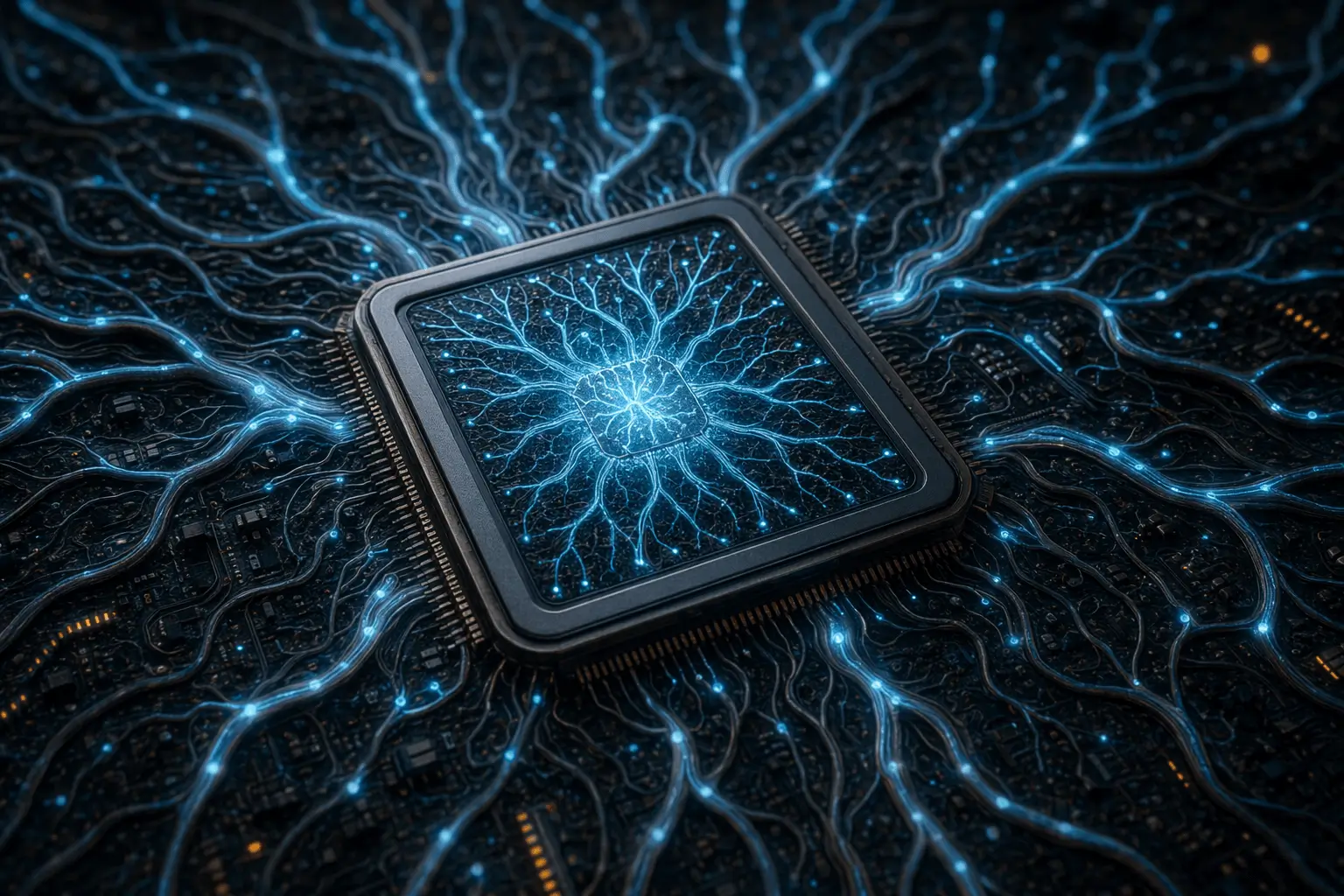
Neuromorphic computing fundamentally abandons the Von Neumann architecture. Instead of separating processing and memory, it integrates them, mimicking the physical structure of biological neurons and synapses.
Spiking Neural Networks (SNNs)
In a biological brain, neurons do not communicate in continuous streams of 1s and 0s. They communicate via “action potentials” - short, electrical spikes that fire only when a specific threshold of stimulation is reached. If a neuron isn’t firing, it isn’t consuming energy.
Neuromorphic chips utilize “Spiking Neural Networks” (SNNs) to mimic this behavior in silicon. Unlike traditional AI chips (like GPUs) that process massive matrices of data simultaneously and continuously (drawing massive power), a neuromorphic chip is “event-driven.” The artificial neurons on the chip remain completely dark and consume near-zero power until a specific input triggers a spike.
In-Memory Computing
Crucially, neuromorphic chips perform “in-memory computing.” The artificial synapses that connect the artificial neurons act as both the processor and the memory storage simultaneously. By eliminating the need to shuttle data back and forth across the chip, neuromorphic designs bypass the Von Neumann bottleneck entirely, resulting in orders-of-magnitude improvements in speed and energy efficiency.
Commercialization and Use Cases
While neuromorphic engineering is incredibly complex, the technology is moving rapidly from academic laboratories into commercial deployment, spearheaded by massive tech conglomerates and agile startups.
The Edge Computing Revolution
The immediate and most lucrative application for neuromorphic chips is edge computing. Because neuromorphic chips consume micro-watts of power, they can be deployed in environments where traditional batteries would drain in hours.
Imagine a tiny, neuromorphic audio sensor deployed in a dense forest to detect the specific acoustic signature of a chainsaw (indicating illegal logging). The sensor can sit dormant for years on a single coin-cell battery. Because the neural processing happens directly on the chip (in-memory), it doesn’t need to constantly transmit audio data to the cloud. When the specific “spike” pattern of a chainsaw is recognized locally, the chip wakes up and sends a single, low-bandwidth alert. This level of hyper-efficient, localized AI processing is impossible with traditional silicon.
Autonomous Systems and Robotics
Neuromorphic chips are uniquely suited for processing sensory data in real-time, making them highly desirable for robotics and autonomous vehicles. A traditional autonomous vehicle processes massive, continuous streams of video data frame-by-frame.
A neuromorphic “event camera” operates differently. It doesn’t capture frames; its individual pixels only record changes in brightness (movement). When paired with a neuromorphic processor, the system only processes what is moving, ignoring the static background entirely. This mimics how the biological human eye and visual cortex process information, allowing a drone or a robot to react to obstacles in microseconds while consuming a fraction of the power of a traditional GPU.
The Major Players
The race to commercialize this hardware is fierce. Intel has invested heavily in its Loihi research chips, demonstrating massive efficiency gains in robotic control and optimization problems. IBM pioneered early analog AI and neuromorphic designs with its TrueNorth architecture, and numerous venture-backed startups are designing specialized spiking neural processors tailored for specific industrial applications.
The Software Bottleneck
If neuromorphic hardware is so superior, why hasn’t it replaced traditional chips entirely? The answer is software.
The entire modern software ecosystem - the programming languages, the compilers, the massive AI frameworks like TensorFlow and PyTorch - is designed to run on the rigid, sequential logic of the Von Neumann architecture.
Programming a Spiking Neural Network requires a completely different paradigm. You are not writing sequential lines of code; you are tuning the timing and thresholds of thousands of asynchronous, chaotic electrical spikes. Creating the software tools, compilers, and training algorithms that allow developers to easily write applications for neuromorphic hardware is currently the industry’s greatest challenge. It requires retraining a generation of computer scientists to think more like neurobiologists.
Conclusion: The Biological Imperative
The computing industry is at a crossroads. The brute-force approach to Artificial Intelligence - throwing exponentially more electricity and massive data centers at inefficient, traditional silicon - is colliding with economic and environmental realities.
Neuromorphic computing represents a fundamental paradigm shift. It acknowledges that billions of years of biological evolution have produced a processing architecture far superior to anything engineered in a human laboratory. While the software ecosystem will take years to mature, the transition to brain-inspired hardware is inevitable.
The companies that successfully bridge the gap between biological efficiency and silicon manufacturing will not only solve the energy crisis facing the tech sector but will unlock a new tier of embedded, ubiquitous, and hyper-intelligent devices that will seamlessly integrate AI into the physical world.