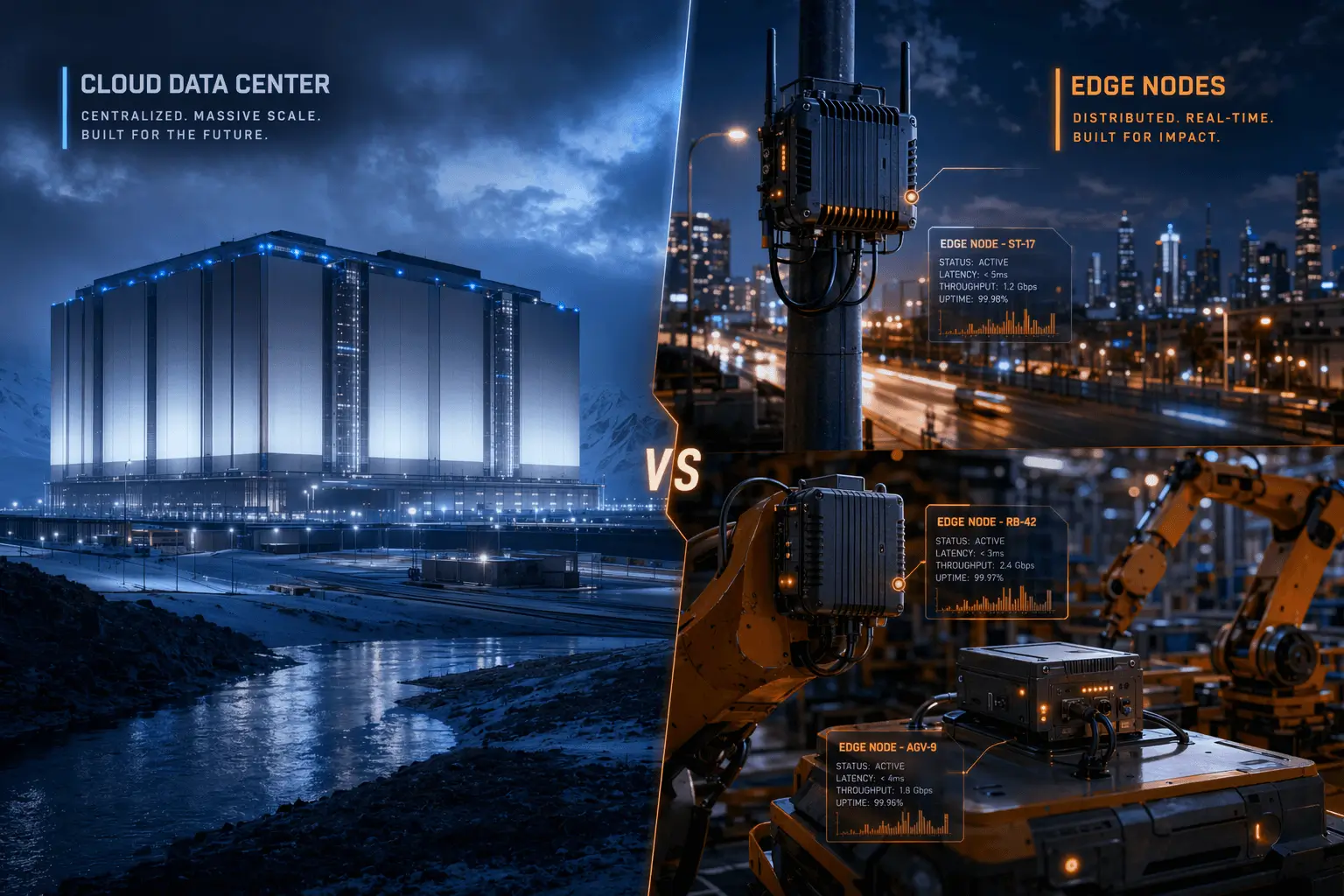
For the past fifteen years, the undisputed king of enterprise technology has been the Cloud. The mantra for Chief Information Officers (CIOs) globally was simple: migrate everything. By moving applications, data storage, and processing power from on-premise servers into massive, centralized data centers owned by hyperscalers like Amazon (AWS), Microsoft (Azure), and Google (GCP), companies achieved unprecedented scalability, cost-efficiency, and flexibility.
However, the pendulum of computing architecture is beginning to swing back toward decentralization. We are entering the era of “Edge Computing.”
This is not the death of the cloud; rather, it is a strategic evolution. As the sheer volume of data generated by the physical world explodes, and as the applications processing that data require instantaneous, real-time responses, the centralized cloud model is encountering the immutable laws of physics. In this deep dive, we will explore the technical limitations driving this shift, the massive industrial applications of edge computing, and the trillion-dollar battle for the infrastructure of the future.
The Physics of Latency: Why the Cloud is Too Slow
To understand why edge computing is necessary, one must understand the concept of latency. Latency is the time it takes for a packet of data to travel from a device (like a smartphone or a sensor), to a server where it is processed, and back again.
The Speed of Light Bottleneck
When a connected device sends data to a centralized cloud server, that data travels through a complex web of cellular towers, fiber-optic cables, and internet exchange points. Even traveling at the speed of light, if a factory in Detroit needs to send data to an AWS data center in Northern Virginia to be analyzed, there is an unavoidable physical delay.
This “round trip” might take 50 to 100 milliseconds. For streaming a movie on Netflix or saving a document to Google Drive, 100 milliseconds is imperceptible. But for the next generation of industrial applications, 100 milliseconds is a catastrophic eternity.
The Bandwidth Tsunami
Furthermore, the sheer volume of data is becoming unmanageable. Consider the regulatory hurdles of autonomous vehicles we analyzed previously. A single self-driving car generates terabytes of high-definition LIDAR and video data every single day.
If millions of autonomous vehicles attempt to stream all of their raw sensor data to a centralized cloud for processing simultaneously, the global cellular networks would instantly collapse under the bandwidth strain. It is economically and physically impossible to transmit every piece of data to the cloud.
Enter the Edge: Processing at the Source
Edge computing solves these physics problems by moving the processing power - the “compute” - out of the centralized data center and placing it as close to the data source as possible. This is the “edge” of the network.
Instead of sending raw data across the country, a device processes the data locally, makes an immediate decision, and then only sends a tiny, summarized packet of relevant data back to the cloud for long-term storage or broad analysis.
What Does the “Edge” Actually Look Like?
The “edge” is not a single location; it exists on a spectrum.
- The Device Edge: The compute happens directly on the device itself. A modern iPhone using its neural engine to process facial recognition instantly, without sending your face to an Apple server, is edge computing.
- The On-Premise Edge: A small, ruggedized server rack sitting on the floor of a manufacturing plant or in the back room of a retail store, processing data for that specific location.
- The Network Edge: As we discussed in our exploration of the impact of 5G on smart cities, telecommunications companies are building “Micro Data Centers” directly at the base of 5G cell towers. This allows mobile devices to access high-performance computing power with single-digit millisecond latency.
The Industrial Transformation
While consumer applications benefit from edge computing (think seamless AR/VR experiences), the true economic driver of this shift is the industrial sector.
Manufacturing and Predictive Maintenance
In a modern, automated factory, thousands of sensors monitor the vibration, temperature, and acoustic signature of robotic assembly lines. If a robotic arm begins to vibrate slightly out of tolerance - indicating an imminent bearing failure - the system must react instantly to shut down the line before catastrophic damage occurs.
Sending that vibration data to a cloud server in another state for analysis introduces too much latency; the machine could destroy itself before the “stop” command returns. An edge server sitting on the factory floor can run an AI model locally, analyze the vibration signature in one millisecond, and halt the machine instantly.
Healthcare and Telesurgery
Hospitals generate massive amounts of highly sensitive data. Advanced MRI machines and continuous patient monitoring systems produce gigabytes of information per second. Edge computing allows hospitals to process this data locally.
This not only ensures real-time analysis for critical patient care but also addresses severe data privacy and compliance regulations (like HIPAA). By processing the data at the edge, the hospital avoids transmitting raw, identifiable patient data across public internet networks. Furthermore, the burgeoning field of robotic telesurgery - where a surgeon operates on a patient remotely - relies entirely on the ultra-low latency guaranteed by 5G and edge nodes.
Retail and Frictionless Commerce
Retailers are deploying edge servers in-store to power the next generation of shopping. Amazon Go’s “just walk out” technology, which uses hundreds of cameras to track exactly what items a customer picks up and automatically charges their account when they leave, is a masterclass in edge computing. The massive visual data processing required to track dozens of people simultaneously must happen locally in the store; the cloud is simply too slow to process that much video data in real-time.
The Trillion-Dollar Infrastructure Battle
The shift to the edge represents a massive land grab in the tech sector, forcing traditional cloud providers, hardware manufacturers, and telecom giants into fierce competition (and reluctant partnership).
The Hyperscalers Move Outward
The major cloud providers are aggressively trying to extend their dominance to the edge. They realize that if they only offer centralized cloud services, they will miss out on the next wave of industrial AI. Programs like AWS Outposts allow companies to purchase a physical AWS server rack and place it in their own factory, running exactly the same APIs and software as the main AWS cloud. They are essentially selling “cloud in a box” to capture the edge market.
The Hardware Resurgence
The edge computing boom is incredible news for semiconductor and hardware companies. Because edge environments are often harsh - subject to extreme temperatures, dust, and vibration - standard data center servers will not survive. Companies like Nvidia are developing specialized, highly ruggedized AI chips designed specifically for edge deployment, creating a massive new revenue stream for advanced silicon.
Conclusion: A Hybrid Future
It is crucial to understand that edge computing does not replace cloud computing; it is a complementary architecture. We are moving toward a hybrid, highly distributed model.
The edge will act as the reflexes of the digital world - handling the immediate, split-second processing required to keep autonomous cars on the road, factory robots synchronized, and AR headsets rendering smoothly. The cloud will act as the brain - handling the deep, long-term learning, training massive AI models on the summarized data sent back from millions of edge nodes, and pushing updated algorithms back out to the edge.
For businesses, the strategic imperative is clear. The era of blindly defaulting to the cloud is over. IT architects must now carefully evaluate every application and ask: Where does this data need to be processed to maximize efficiency and minimize latency? The companies that master this delicate balance between the cloud and the edge will build the most resilient, hyper-responsive infrastructure of the next decade.