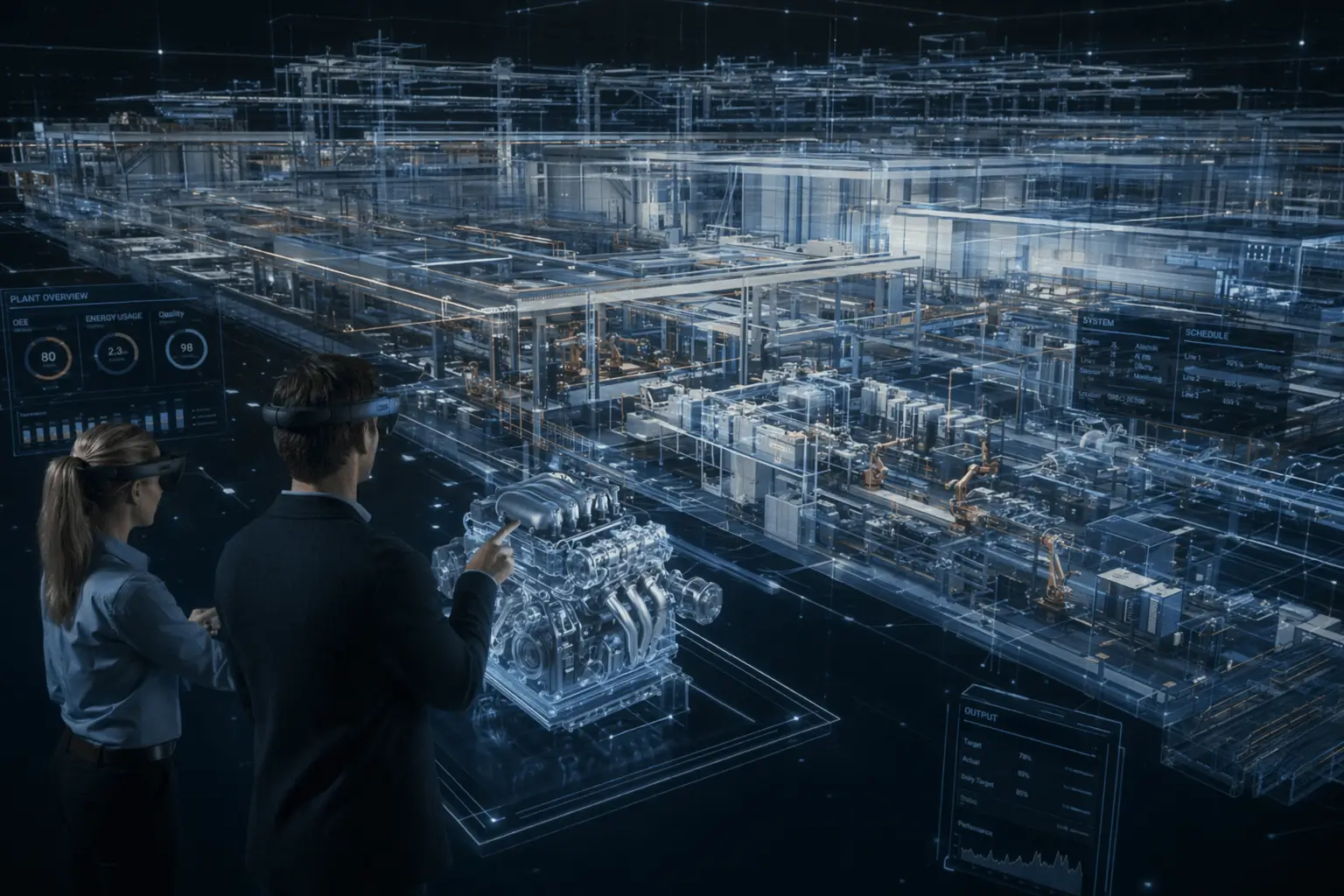
In late 2021, the tech world was consumed by a singular, overwhelming buzzword: The Metaverse. Driven by Mark Zuckerberg’s decision to rebrand his entire trillion-dollar company to Meta, the narrative suggested that humanity was on the verge of migrating into a fully immersive, 3D internet. Billions of dollars in venture capital flooded into startups building virtual real estate, digital fashion brands, and VR social clubs.
Two years later, the consumer Metaverse hype cycle collapsed spectacularly. The headsets were too heavy, the graphics were often cartoonish, and the fundamental question - “Why do I want to have a business meeting as a legless cartoon avatar?” - remained unanswered. The mainstream media largely wrote off the Metaverse as a multi-billion-dollar failure.
This narrative is dangerously incomplete. While the consumer Metaverse struggled to find product-market fit, the Industrial Metaverse has been quietly and aggressively scaling. Major corporations are ignoring the hype of digital real estate and instead utilizing advanced spatial computing to fundamentally restructure how they design, manufacture, and maintain the physical world. In this analysis, we will explore the concept of the “Digital Twin,” the massive cost savings of spatial collaboration, and why the boring, industrial applications of the Metaverse will ultimately define its success.
The Core Technology: The Digital Twin
The foundational technology of the Industrial Metaverse is the “Digital Twin.” A digital twin is a hyper-accurate, real-time, 3D digital replica of a physical object, system, or environment.
Moving Beyond the Blueprint
Historically, if a company wanted to build a new factory, they designed it using 2D blueprints or static 3D CAD models. Once the factory was built, if an engineering flaw was discovered - perhaps a robotic arm on the assembly line didn’t have enough clearance to rotate fully - it required incredibly expensive physical retrofitting to fix.
In the Industrial Metaverse, the company builds the entire factory digitally first. This digital twin is not just a visual model; it incorporates advanced physics engines. Engineers can simulate gravity, thermal dynamics, and fluid flow within the digital environment. They can program the digital robotic arms to run a full production cycle, identifying bottlenecks and clearance issues in silicon, long before a single piece of concrete is poured in the physical world.
Real-Time Synchronization
The true power of the digital twin is unlocked when the physical object is actually built. As we explored in our piece on the impact of 5G and IoT, modern infrastructure is covered in sensors.
By streaming this real-time IoT data back to the digital twin, the virtual model becomes a living, breathing replica of the physical asset. A manager sitting in an office in London can put on a mixed-reality headset and virtually “walk” through a digital twin of an offshore oil rig located in the North Sea. By looking at a digital pump, they can see the exact, real-time temperature, vibration, and flow rate of the physical pump thousands of miles away, enabling predictive maintenance before a catastrophic failure occurs.
Spatial Collaboration and the Future of Work
The Industrial Metaverse is also solving one of the most persistent challenges of the globalized economy: training and remote collaboration for highly complex physical tasks.
The End of the “Fly-and-Fix” Model
Consider a scenario where a multi-million-dollar MRI machine breaks down in a rural hospital. Historically, the manufacturer would have to fly a highly specialized technician across the country to diagnose and fix the machine, resulting in days of downtime.
Using Industrial Metaverse platforms like Microsoft Mesh, a local, general technician at the hospital can put on an Augmented Reality (AR) headset. The expert technician, sitting in a centralized hub, can see exactly what the local technician sees. More importantly, the expert can project 3D holographic annotations directly into the local technician’s field of view - drawing an arrow pointing to the exact wire that needs to be cut, or overlaying a 3D animation showing how to remove a specific valve. This allows companies to instantly deploy their highest-tier expertise globally, without anyone ever boarding an airplane.
Revolutionizing Enterprise Training
This spatial technology is also revolutionizing corporate training. Instead of reading a manual or watching a 2D video on how to repair a jet engine, new mechanics can train in a fully immersive VR simulation. They can practice tearing down and rebuilding a virtual jet engine hundreds of times, building muscle memory and making mistakes in a zero-risk digital environment. This drastically reduces training costs and significantly improves safety when the mechanic eventually transitions to the physical hangar.
The Convergence with Augmented Retail
It is important to note that the technologies powering the Industrial Metaverse are bleeding into consumer-facing applications, though in much more practical ways than the initial “VR Chat” hype suggested.
As we analyzed in our deep dive on Augmented Reality in Retail, the Metaverse is not necessarily about escaping to a purely digital world; it is about augmenting the physical world with digital data. When a consumer uses their smartphone to project a true-to-scale 3D model of a sofa into their living room before buying it, they are interacting with a localized, consumer-grade digital twin. The backend infrastructure required to render that sofa flawlessly is identical to the infrastructure rendering the automotive factory.
The Bottlenecks: Interoperability and Hardware
Despite the massive enterprise adoption, the Industrial Metaverse still faces significant technical hurdles.
The Walled Gardens
Currently, the Metaverse is highly fragmented. A digital twin built using Siemens software cannot easily interact with a digital environment built using Nvidia’s Omniverse platform. For the Metaverse to achieve its true potential - a seamless, interconnected 3D internet - the industry must agree on universal, open-source file formats and interoperability standards, similar to how HTML protocols govern the 2D web.
The Hardware Reality
Furthermore, while enterprise companies can afford to purchase $3,500 mixed-reality headsets for their elite engineers, that hardware is still far too heavy, expensive, and battery-constrained for all-day use by the average frontline worker. The ultimate success of the spatial computing era relies on the hardware eventually shrinking into lightweight, stylish glasses indistinguishable from standard eyewear.
Conclusion: The Quiet Revolution
The narrative that the Metaverse is dead is fundamentally flawed. What died was the irrational exuberance surrounding a consumer-focused, purely virtual escapism.
What remains is a massive, highly capitalized industrial revolution. By building hyper-accurate digital replicas of the physical world, global corporations are fundamentally reducing the cost of design, eliminating the friction of distance, and radically improving the efficiency of physical maintenance. The Industrial Metaverse is not a game; it is the new operating system for the global physical economy.