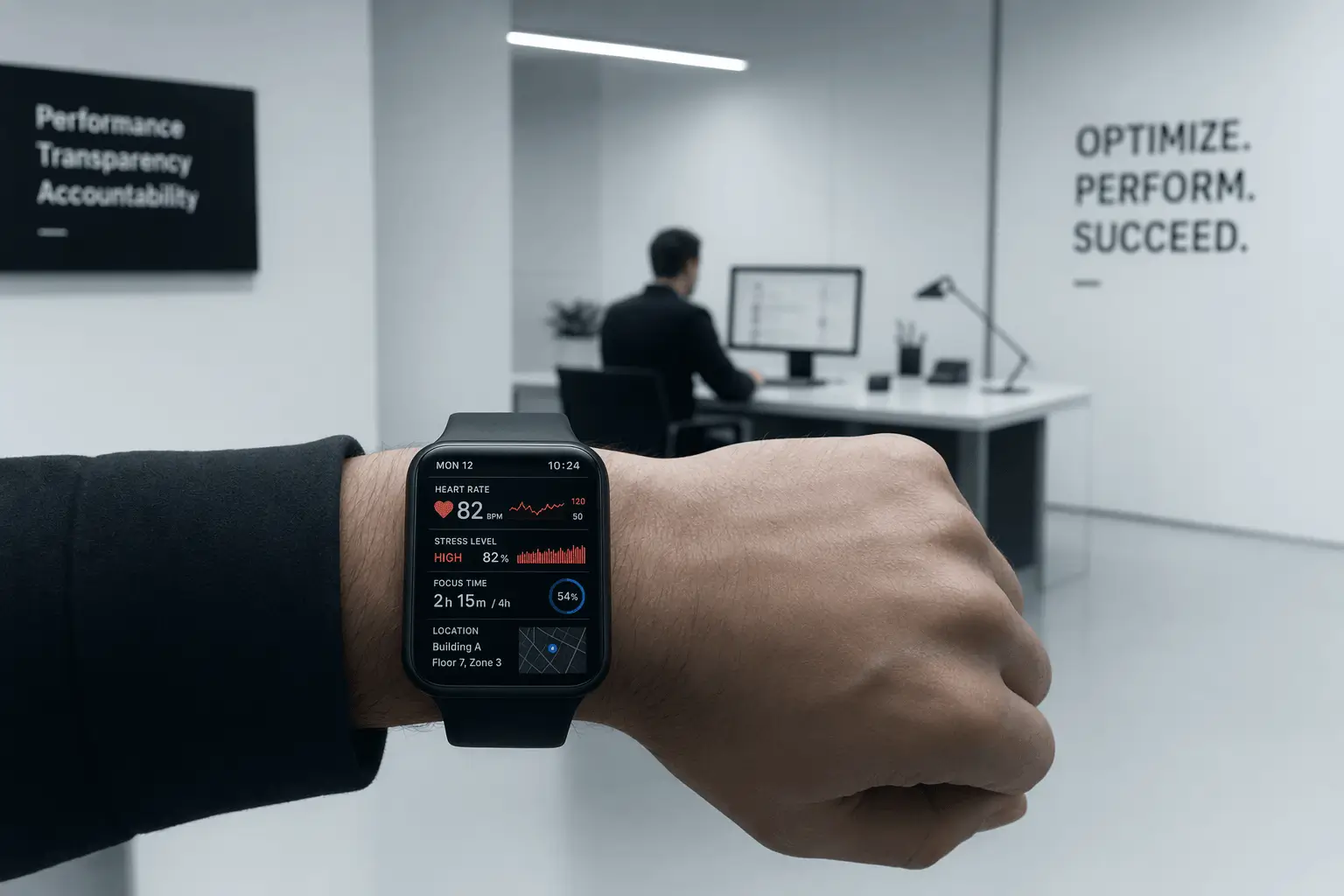
In the consumer market, wearable technology is ubiquitous. Millions of people willingly strap smartwatches and fitness rings to their bodies to track their steps, monitor their sleep cycles, and analyze their heart rate variability. The value proposition is simple: trade biological data for personalized health insights.
Now, this technology is aggressively crossing the threshold from the personal sphere into the corporate environment. Driven by the relentless pursuit of workflow optimization and the complex management of a distributed workforce, companies are deploying “Enterprise Wearables” at scale.
From construction sites to corporate boardrooms, employers are exploring how biometric data can reduce insurance premiums, prevent workplace accidents, and quantify the elusive metric of “employee engagement.” However, the deployment of corporate biometric trackers ignites a massive ethical and legal firestorm. In this analysis, we will explore the tangible business benefits of enterprise wearables, the chilling reality of biological surveillance, and the desperate need for a new legal framework to protect workers in the age of quantified labor.
The Business Case for the Bionic Worker
The argument for enterprise wearables is rooted in safety, efficiency, and the harsh realities of corporate insurance.
Heavy Industry and Predictive Safety
The clearest use case for enterprise wearables is in physically demanding industries: construction, manufacturing, and logistics.
Consider a warehouse worker lifting heavy boxes for an eight-hour shift. A smart belt equipped with accelerometers and gyroscopes can track the exact angle of the worker’s spine during every single lift. If the worker begins to exhibit “fatigue mechanics” - rounding their back or lifting with improper form - the belt vibrates instantly, providing a haptic correction before a catastrophic spinal injury occurs.
Furthermore, wearable biometric monitors can track a construction worker’s core body temperature and heart rate during a summer heatwave. If the software detects the early physiological markers of heatstroke, it can automatically alert a supervisor to pull the worker off the site. By proactively preventing these injuries, companies save millions of dollars in workers’ compensation claims and drastically lower their corporate insurance premiums.
The Knowledge Worker and “Focus Analytics”
While physical safety is the primary driver in heavy industry, the deployment of wearables among “knowledge workers” (lawyers, software engineers, accountants) is far more controversial. Here, the goal is optimizing mental output.
As we discussed in our piece on the future of remote work, managers are struggling to measure the productivity of a distributed workforce. Some firms are experimenting with providing employees with high-end smartwatches or EEG headbands (which measure brainwave activity) to track “focus states.”
The theoretical pitch is that by correlating an employee’s biological data (sleep quality the night before, resting heart rate, cortisol levels) with their software output (lines of code written, emails sent), the company can algorithmically determine the employee’s peak productivity hours. The software might suggest that an employee is too biologically stressed to tackle a complex task at 2:00 PM, automatically rescheduling their deep-work block for the following morning.
The Privacy Nightmare: Biological Surveillance
While the productivity pitch is enticing for Chief Operations Officers, the implementation of these devices represents an unprecedented invasion of privacy. It transforms the employer-employee relationship from a transaction of time-for-money into a state of continuous biological surveillance.
The Coercion of “Voluntary” Programs
Currently, most corporate wellness and wearable programs are branded as “voluntary.” Employees are offered a free Apple Watch or a discount on their health insurance premiums if they agree to share their daily step counts and sleep data with a third-party corporate wellness platform.
However, organizations like the Electronic Frontier Foundation (EFF) argue that in a corporate power dynamic, “voluntary” is an illusion. If a company creates a culture where wearing the tracking device is viewed as being a “team player,” and those who opt-out are subtly penalized in performance reviews or denied insurance discounts, the program is effectively mandatory through coercion.
The Misuse of Biological Data
The primary fear is how this highly sensitive, biological data will be used against the employee.
If an enterprise smartwatch detects that an employee is consistently experiencing elevated stress levels and poor sleep, will the HR department use that data to preemptively offer mental health resources, or will they use that data to quietly pass the employee over for a high-pressure promotion, assuming they cannot handle the stress?
Furthermore, biological data can reveal protected medical conditions. An erratic heart rate might indicate an undisclosed pregnancy or a chronic heart condition. If an employer has access to this data, it opens the door to massive, algorithmically driven workplace discrimination, directly violating the principles we explored regarding the ethics of data monetization.
The Legal and Regulatory Vacuum
The law is fundamentally ill-equipped to handle the reality of the bionic worker. Existing labor laws and privacy regulations (like HIPAA in the United States) were written in an era where medical data was generated exclusively in a doctor’s office, not on a factory floor.
The Ownership of Biometric Data
Who legally owns the heart rate data generated by a corporate-issued smartwatch during a weekend? Can the employer sell that aggregated, “anonymized” biometric data to a third-party pharmaceutical research firm? If the employee leaves the company, does the company retain the right to keep their historical biological baseline data?
These questions are currently being litigated in courts globally. According to technology research firm Gartner, the lack of clear regulatory guidance is the primary bottleneck preventing wider enterprise adoption. Companies are terrified of deploying these systems, only to face massive class-action lawsuits for violating biometric privacy laws (such as the incredibly strict Biometric Information Privacy Act in Illinois).
Conclusion: The Boundary of the Human Body
The integration of wearable technology into the enterprise is inevitable. The financial incentives to prevent workplace injuries and hyper-optimize knowledge worker output are simply too massive for corporations to ignore.
However, we are rapidly approaching a dangerous ethical threshold. The corporate monitoring of email, web traffic, and physical location is already widely accepted. But crossing the barrier of the skin - monitoring an employee’s internal biological state - represents a profound shift in the social contract of labor.
If society does not establish aggressive, explicit legal boundaries regarding exactly what biological data an employer can collect, how it can be used, and the harsh penalties for its misuse, we risk creating a dystopian workplace where employees are managed not as human beings, but as biological machines subject to continuous, algorithmic optimization. The true challenge of the 2020s is not developing the technology to track the bionic worker, but developing the morality to protect them.